


Choosing the right aftermarket wheels starts with fitment, not style. To know whether a wheel will work on your vehicle, you need to verify seven core specs: diameter, width, bolt pattern, offset, center bore, lug seat type, and load rating. One incorrect measurement can cause rubbing, vibration, brake clearance issues, or improper mounting - even if the wheel bolts on and holds air just fine.
Most wheel fitment problems show up only once the vehicle moves. A wheel can match your lug pattern and still sit too far inward, contact suspension components, fail to center properly on the hub, or carry the wrong load. That is why wheel fitment is not just about size - it is about how the wheel mounts, clears, centers, and supports weight under real driving conditions.
This guide explains how wheel fitment works, how to read wheel specs, what each measurement controls, and how to avoid the most common mistakes when buying aftermarket wheels.
A Wheel Can Bolt On and Still Be Wrong
Wheel fitment is the relationship between a wheel's dimensions and the way it mounts on your vehicle. A wheel fits correctly when it matches the vehicle's mounting pattern, clears brake and suspension components, centers properly on the hub, and supports the vehicle's load without interference.
A wheel that is slightly off in one area may still install. That does not mean it fits correctly once driven, loaded, steered, or compressed over a pothole. Incorrect fitment can place the wheel too close to suspension, reduce brake clearance, shift steering geometry, overload bearings, or cause vibration at highway speed that no balancing job will fix.
This is why two wheels with the same diameter can fit very differently. An 18-inch wheel only describes barrel diameter. Width, offset, bolt pattern, center bore, lug seat type, and spoke clearance determine where the wheel sits, how it mounts, and whether it operates safely under load.
Correct wheel fitment directly affects:
- Whether the wheel mounts safely and fastens correctly
- Whether brakes and suspension clear under movement and compression
- Whether the wheel centers properly on the hub
- Whether the steering geometry stays within a usable range
- Whether bearing load remains stable
- Whether the tire sits correctly inside the wheel well
How to Read Wheel Size
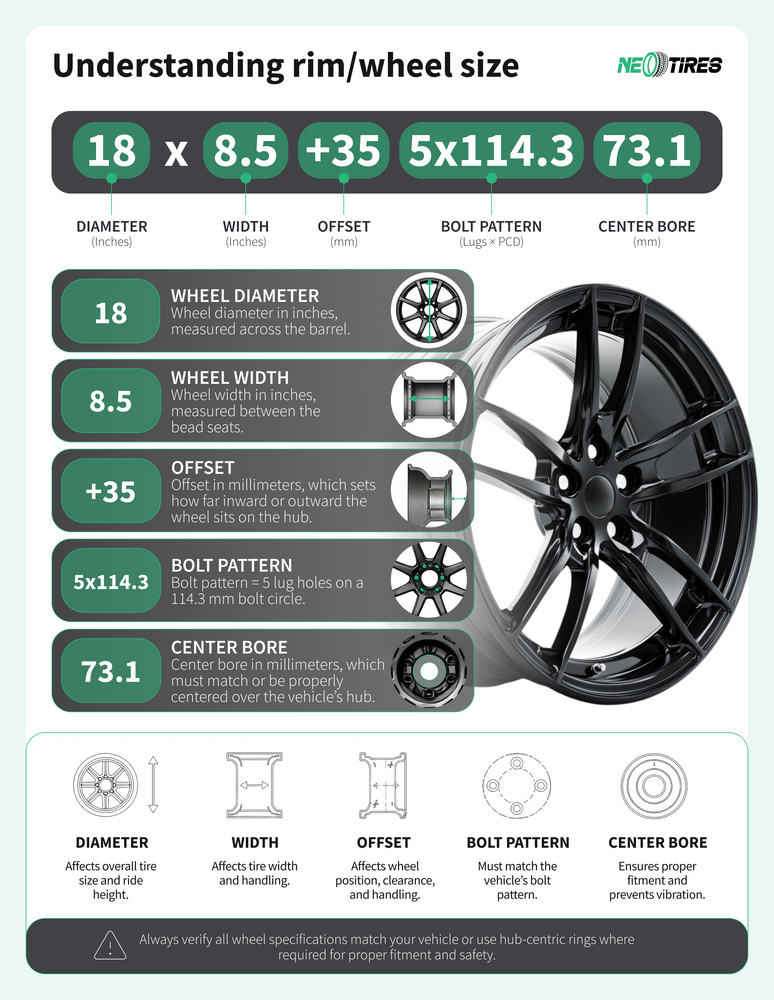
Wheel/rim size is expressed as a sequence of measurements that define how the wheel mounts, where it sits, and what vehicle fitment it supports. In aftermarket listings, these specs are usually shown in a single line because each value controls a different part of fitment.
A wheel /rim labeled 18x8.5 +35 5x114.3 73.1 is read left to right:
- 18 = wheel diameter in inches, measured across the barrel
- 8.5 = wheel width in inches, measured between the bead seats
- +35 = wheel offset in millimeters, which sets how far inward or outward the wheel sits on the hub
- 5x114.3 = bolt pattern - 5 lug holes on a 114.3 mm bolt circle
- 73.1 = center bore in millimeters, which must match or be properly centered over the vehicle's hub
Together, these measurements determine whether the wheel bolts to the hub, where it sits inside the wheel well, whether it clears brakes and suspension, and whether it can be driven safely. Reading wheel size correctly means understanding what each number controls before you buy.
7 Specs That Decide If Your Wheels Actually Fit
1. Wheel Diameter
Wheel diameter is the height of the wheel measured across the barrel, in inches. In the U.S. aftermarket, passenger-wheel diameters typically range from 16" to 20", with 18" and 19" among the most common upgrade sizes for sedans, crossovers, and SUVs. Economy cars and older platforms frequently use 16" or 17" factory fitments, so the correct starting point depends on your vehicle, not a general range.
Diameter determines what tire size the wheel can accept because the tire's inner bead must match the wheel's diameter exactly. A 225/45R18 tire fits an 18-inch wheel. It will not mount on a 17-inch or 19-inch wheel, regardless of width or overall tire height.
Wheel diameter also affects brake clearance, sidewall height, and ride behavior. Moving from a factory 17" or 18" wheel to a 19" or 20" aftermarket setup typically means:
- Shorter tire sidewalls to maintain a similar overall tire height
- More visible brake clearance inside the barrel
- Firmer ride response due to reduced sidewall flex
- Lower impact absorption over potholes and rough pavement
Moving from 17" to 19", for instance, usually requires a lower-profile tire to maintain the correct overall diameter. That reduces sidewall depth, which sharpens steering feel but also increases road harshness and the risk of damage from sharp-edged impacts. A larger diameter can improve brake clearance and support a more aggressive setup, but it must remain within the vehicle's usable tire and fitment range.
2. Wheel Width
Wheel width is measured between the inside bead seats, in inches. In the U.S. aftermarket, common passenger-wheel widths run from 7.5" to 10", with 8" and 8.5" among the most typical fitments for daily-driven sedans, crossovers, and SUVs.
Width determines what tire width the wheel can support and how that tire sits once mounted. A 225 mm tire is commonly paired with wheels in the 7.5" to 8.5" range, while a 255 mm tire is more typically matched with 8.5" to 9.5" widths - though the exact approved range varies by tire manufacturer.
What many buyers don't account for is that wheel width and offset always work together. Adding 1 inch of wheel width changes total wheel position by 1.00 inch (25.4 mm), split roughly equally: about 0.50 inch (12.7 mm) moves inward, and 0.50 inch (12.7 mm) moves outward - before offset is factored in. So a change from 18x8" to 18x9" does not just mean a wider tire. It also moves the inner barrel closer to the suspension and pushes the outer lip closer to the fender, even if the offset number stays identical.
Wheel width directly affects how the tire sidewall sits, how the contact patch behaves under load, inner and outer clearance on both sides of the wheel well, and how much lateral support the tire has during cornering.
3. Bolt Pattern
Bolt pattern is the number of lug holes on the wheel and the diameter of the circle they form around the hub, written as lug count × bolt circle diameter in millimeters. For example, 5x114.3 means five lug holes spaced on a 114.3 mm bolt circle.
The bolt pattern must be verified first because it determines whether the wheel can physically mount to the hub at all. If the bolt pattern is wrong, the wheel will not seat correctly against the mounting surface - and that problem does not disappear if you can get the lug nuts started. 5x112 and 5x114.3 look nearly identical on paper, but that 2.3 mm difference is enough to prevent proper lug seating, create off-center mounting stress, and cause loosening under load.
Common U.S. aftermarket bolt patterns include:
- 5x114.3 - many sedans, crossovers, and Japanese platforms
- 5x112 - many European vehicles
- 5x120 - many BMW and GM applications
- 6x139.7 - trucks and body-on-frame SUVs
The bolt pattern must match exactly before any other fitment spec is evaluated. Read the full breakdown in our dedicated article: Understanding Wheel Bolt Patterns.
4. Wheel Offset
Wheel offset is the distance between the wheel's mounting pad and its centerline, measured in millimeters. It determines how far inward or outward the wheel sits once bolted to the hub.
Zero offset means the mounting pad sits exactly at the wheel's centerline - the reference point from which positive and negative offset are measured.
Positive offset moves the mounting pad toward the front (street side) of the wheel, pulling the wheel inward, closer to the suspension. Most modern passenger cars and crossovers run a positive offset from around +35 to +50.
Negative offset moves the mounting pad toward the back of the wheel, pushing it outward - away from the suspension and toward the fender.
A wheel can have the correct diameter and a matching bolt pattern and still contact a strut, rub a fender liner, or alter steering feel significantly if the offset is wrong. Offset mistakes are among the most common causes of wheel rub on vehicles where the wheel visually "fits" until the suspension compresses or the steering reaches full lock. Read the full breakdown on Wheel Offset in our dedicated guide.
5. Center Bore
Center bore is the diameter of the hole in the center of the wheel that fits over the vehicle's hub, measured in millimeters. This is what locates the wheel on its true centerline before the lug hardware is tightened. The lug nuts clamp the wheel in place, but it is the center bore - not the lugs - that centers it.
If the center bore is smaller than the hub diameter, the wheel simply will not seat. If it is larger, the wheel can still mount, but it must be properly centered using hub-centric rings that fill the gap precisely. Skip the rings, and the wheel can sit slightly off-center during installation - a condition that typically shows up as highway vibration that no balancing job fully resolves, because the wheel is not rotating on its true center.
Center bore is one of the most commonly overlooked fitment measurements, partly because the problem is invisible at installation and only reveals itself at speed. A wheel with a 73.1 mm bore can physically fit on a vehicle with a 66.1 mm hub - but without the correct hub ring closing that gap, a persistent vibration issue is almost guaranteed within a few hundred miles.
6. Lug Seat Type
Lug seat type is the shape of the contact area between the lug nut (or lug bolt) and the wheel's mounting hole. A mismatch here can prevent proper wheel fastening even when the bolt pattern is correct.
The two most common types are:
- Conical (tapered) seat - the lug nut has an angled cone that seats into a matching tapered hole in the wheel. Most common on U.S. and Japanese vehicles.
- Ball (radius) seat - the lug nut has a rounded, curved contact surface that mates with a spherical recess in the wheel. Common on BMW, Mercedes-Benz, and Volkswagen Group platforms.
Installing a conical lug nut on a ball-seat wheel creates point loading instead of full surface contact - leading to uneven clamping force, potential loosening under load, and fastener damage over time. Always confirm the lug seat type required by the wheel and match the hardware accordingly before installation.
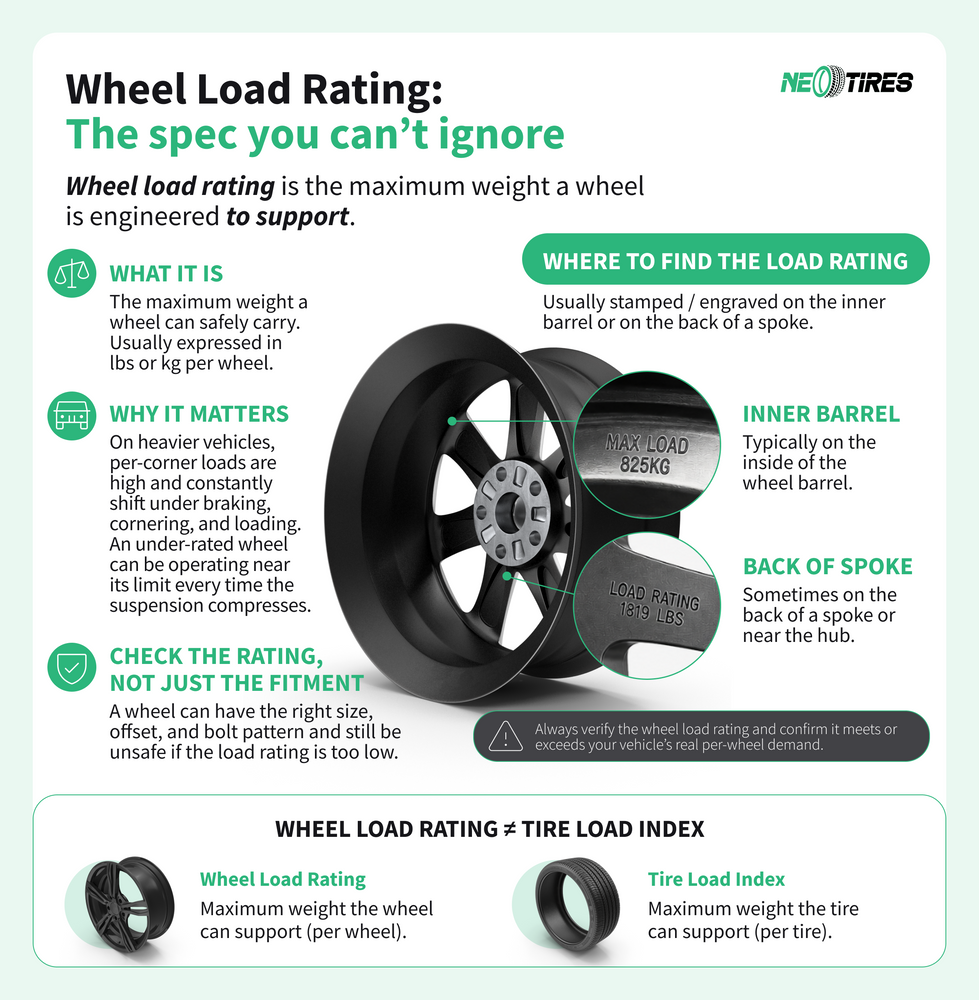
7. Wheel Load Rating
Wheel load rating is the maximum weight a wheel is engineered to support - a separate figure from the tire's load index, which is a common point of confusion.
Wheel load rating is usually expressed in pounds or kilograms per wheel and reflects the maximum static load that the wheel can safely carry under normal use. On heavier crossovers, SUVs, and EVs, the actual per-corner load can be significant, and it shifts constantly under braking, cornering, and loading. A wheel that barely meets static curb weight numbers may be operating near its structural limit every time the suspension compresses on an uneven road.
A wheel may match the correct diameter, width, bolt pattern, and offset and still be unsuitable if its load rating falls short of the vehicle's real per-wheel demand. This spec is frequently skipped in favor of visual fitment checks - which is exactly why it warrants explicit verification before purchase.
What Goes Wrong When One Wheel Spec Is Off
Wrong Spec | What Goes Wrong |
Bolt pattern | Wheel will not seat or fasten correctly |
Center bore | Wheel may mount off-center and cause persistent vibration |
Offset | Wheel may rub suspension, poke outward, or alter steering response |
Width | Tire position changes; clearance may be lost on one or both sides |
Diameter | Brake clearance or tire fitment may be compromised |
Lug seat type | Improper fastening; risk of loosening under load |
Load rating | Wheel may be structurally unsuitable for the vehicle's real load |
Many of these issues are not visible while the vehicle is parked. They appear under steering lock, suspension compression, braking, or highway speed.
OEM vs Aftermarket: What Changes Beyond the Look
OEM wheels are manufactured to factory vehicle specifications with no deviation. Aftermarket wheels are built to fit one or more vehicle applications while offering greater choice in size, width, offset, finish, and design.
The main advantage of aftermarket wheels is flexibility - wider widths, larger diameters, different offsets, and upgraded aesthetics are all possible. But the further a wheel moves from factory specs, the more important offset, center bore, and clearance verification become.
A small offset change is manageable with the right tire combination; an aggressive width increase paired with a low offset on a vehicle with tight fender clearance creates a real-world fitment problem, not just a spec-sheet one.
Alloy, Steel, or Forged: Which One Is Right for You
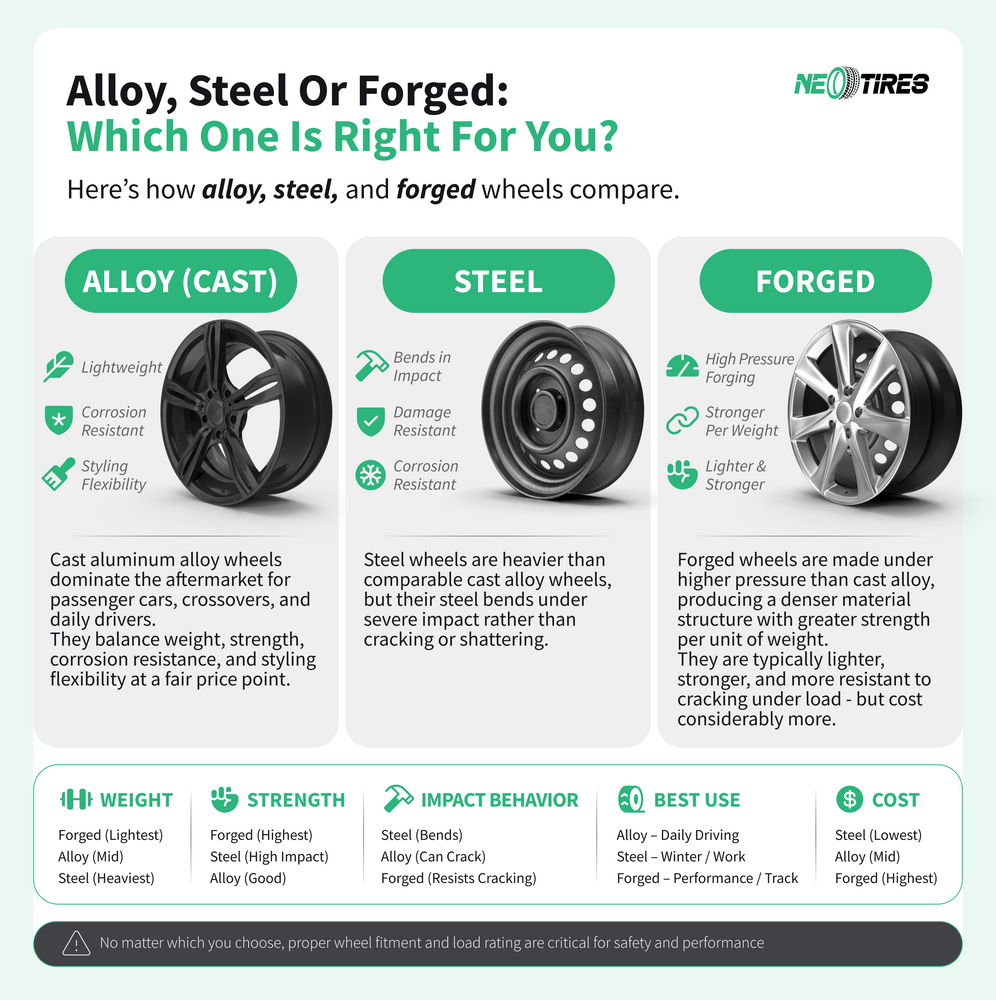
Cast aluminum alloy wheels dominate the aftermarket for passenger cars, crossovers, and daily drivers. They balance weight, strength, corrosion resistance, and styling flexibility at a price point that works for most buyers.
Steel wheels are heavier than comparable cast alloy wheels, but they have a meaningful structural advantage: steel bends under severe impact rather than cracking or shattering. On an alloy wheel, a hard hit from a pothole or curb can fracture a spoke or crack the barrel - a failure that can be sudden and difficult to detect. A steel wheel deforms instead, which is less catastrophic and more likely to be noticed before it becomes a safety issue. That makes steel the practical choice for winter setups, utility applications, and work vehicles where damage resistance matters more than weight or appearance.
Forged wheels are manufactured under significantly higher pressure than cast alloy, producing a denser material structure with greater strength per unit of weight. Compared to cast alloy, forged wheels are typically lighter, stronger, and more resistant to cracking under load - but they cost considerably more and are rarely the starting point for everyday aftermarket builds. They are common in track and premium performance applications where weight savings justify the investment.
Why TPMS Is a Fitment Issue, Not an Afterthought
Any vehicle manufactured after September 2007 in the U.S. is equipped with a Tire Pressure Monitoring System. When switching to aftermarket wheels, TPMS is a practical fitment consideration that belongs on the checklist alongside bolt pattern and offset - not an afterthought addressed at the installer.
Most factory TPMS sensors are mounted inside the wheel on the valve stem. Aftermarket wheels may require:
- Relocating existing sensors if the valve stem position is compatible
- Purchasing new TPMS sensors matched to the wheel's valve mounting style
- Programming new sensors to the vehicle's ECU
A set of aftermarket wheels that passes every other fitment check can still trigger a persistent warning light - or require additional hardware and programming cost - if sensor compatibility was not confirmed upfront.
How to Verify Wheel Fitment Before You Buy
The safest way to select aftermarket wheels is to verify fitment in sequence, not by appearance.
- Start with OEM specs - note the factory diameter, width, bolt pattern, offset, and center bore as your baseline
- Match the bolt pattern exactly - this is a hard requirement with no workaround
- Confirm diameter and width - choose a size that the vehicle can support without clearance problems
- Verify offset range - understand where the wheel will sit relative to suspension and fender edges before ordering
- Check center bore - match the hub bore or confirm hub-centric rings are available for the application
- Confirm lug seat type - match lug hardware to the wheel's mounting hole geometry
- Verify load rating - ensure the wheel meets or exceeds the vehicle's actual per-wheel load demand
- Confirm brake clearance - check spoke and barrel clearance around calipers and rotors
- Verify TPMS compatibility - plan for sensor relocation or replacement before installation
Wheel Fitment Mistakes That Only Show Up While Driving
Most fitment problems trace back to a single overlooked spec. The trouble is that many of them are invisible at installation and only surface under driving conditions, which is what makes them expensive.
- Assuming bolt pattern is enough - it confirms mounting geometry, not fitment
- Ignoring offset - the most common cause of rub and clearance issues
- Overlooking the center bore - typically reveals itself as highway vibration weeks after install
- Choosing width without checking clearance on both sides - inner and outer clearance both change with width
- Skipping load rating - particularly risky on heavier vehicles and EVs
- Assuming all wheels of the same diameter fit the same - diameter alone says almost nothing about fitment
- Using the wrong lug seat type - creates unsafe fastening conditions that may not be obvious until a lug loosens
- Ignoring TPMS - leads to warning lights and additional cost post-purchase
- Buying for appearance before confirming specifications - finish and spoke design are irrelevant if the fitment is wrong
Aftermarket Wheels for Daily Driving: Where Buyers Go Wrong
For daily use, the best aftermarket wheel is usually the one that stays close to a workable factory fitment while improving appearance, finish, or tire support. Pushing width or offset to the edge of available clearance might look aggressive in the driveway, but it creates real compromises every time you load the car, take a corner at speed, or hit an uneven surface.
For most passenger cars, crossovers, and daily-driven SUVs, a well-chosen aftermarket setup keeps three things under control:
- overall wheel diameter within a usable factory-adjacent range
- wheel width within a practical tire-supported range
- offset close enough to the factory to avoid unnecessary clearance and steering changes.
As a practical reference point: moving from an OEM 17x7" +45 setup to an aftermarket 18x8" +40 is a manageable daily-driver change - moderate width increase, offset within a usable range, and room for practical tire sizing. Jumping to a 19x9.5" +25 on the same vehicle often means reduced inner suspension clearance, more fender exposure, heavier steering feel, and a low-profile tire that transfers significantly more road impact into the cabin.
A properly sized cast alloy wheel with moderate width, correct hub fitment, and a practical offset range will outperform an aggressive setup in everyday use - and give tires and suspension a longer service life in the process.
Final Wheel Fitment Checklist Before Buying
Before purchasing aftermarket wheels, confirm all of the following:
- Wheel diameter - matches the intended tire size and clears the brake package
- Wheel width - supports the intended tire width without compromising inner or outer clearance
- Bolt pattern - matches the hub exactly
- Offset - keeps the wheel in a usable position relative to suspension and fender edges
- Center bore - matches the hub or can be properly hub-centered with the correct ring
- Lug seat type - matches the required lug hardware geometry
- Wheel load rating - meets or exceeds real per-wheel vehicle load demand
- Brake clearance - clears calipers and the spoke-to-brake profile
- Tire compatibility - supports the intended tire size within its approved rim-width range
- Suspension clearance - clears struts, knuckles, control arms, and inner liners through full travel
- Fender clearance - clears outer arches through the steering lock and full suspension compression
- TPMS compatibility - sensor relocation or replacement planned before installation
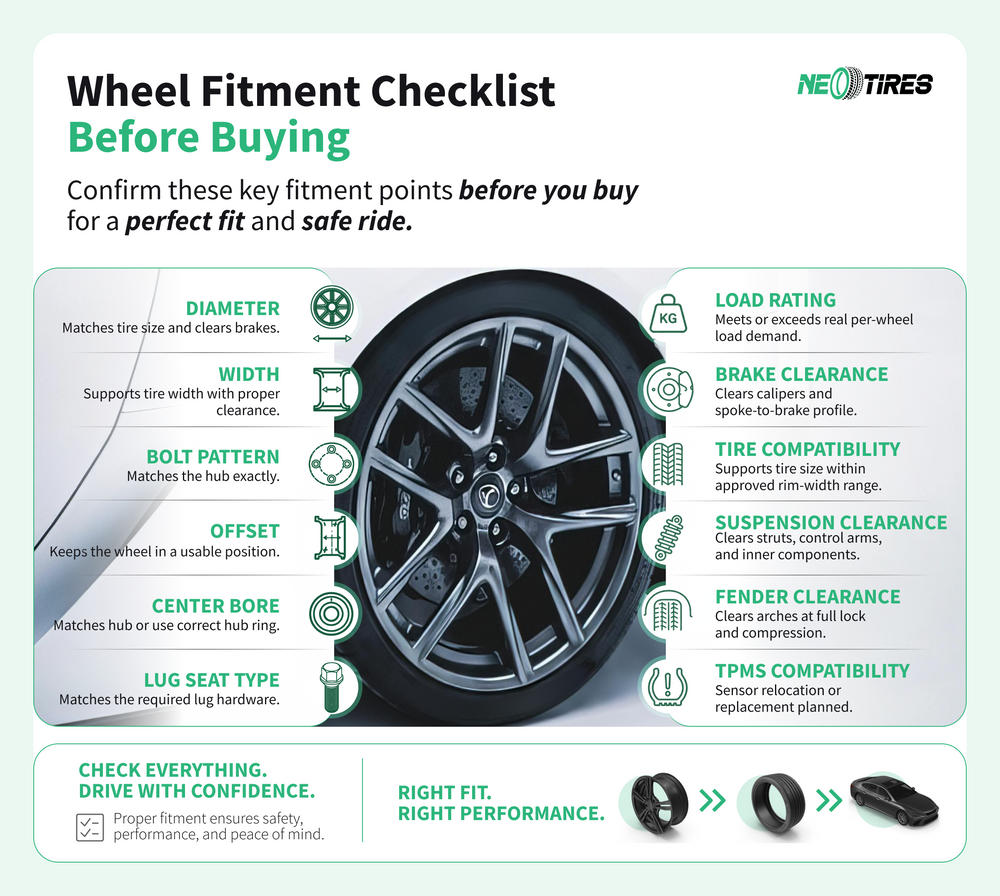
If any one of these measurements is wrong, the wheel may install but will not perform correctly under real driving conditions. Once fitment is confirmed across all specs, comparing brands, finishes, and designs within the specifications your vehicle can actually support becomes a much simpler decision.