


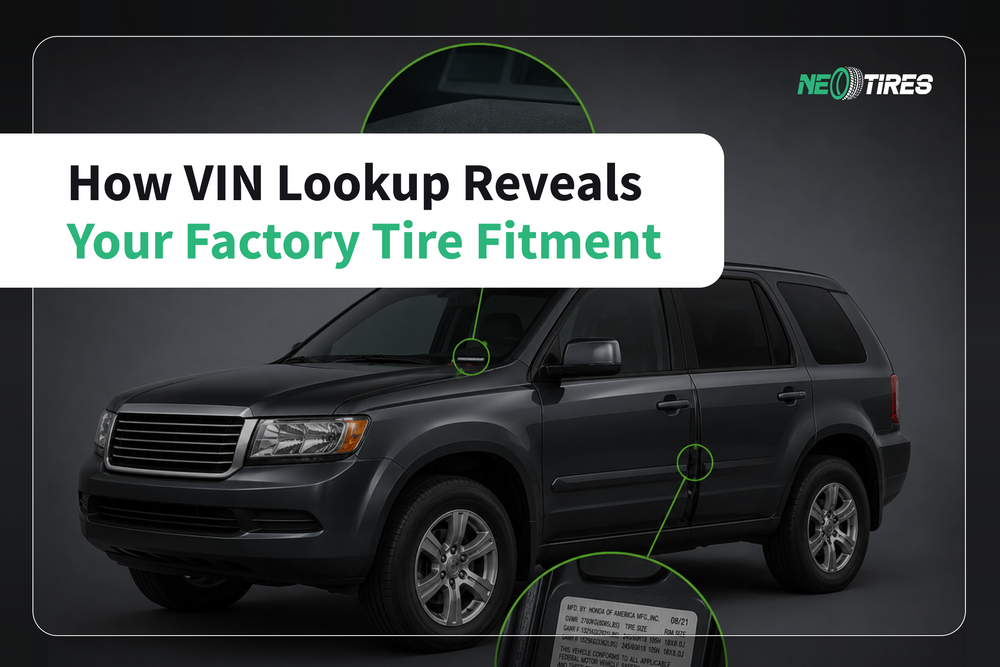
Most drivers look up their VIN when buying a used car or checking for recalls. What they don't realize is that five specific digits inside that 17-character code - positions 4 through 8 - contain the trim and configuration data that determines every tire size their car was factory-approved to run. The door jamb sticker often shows only one of those configurations. What a previous owner may have changed leaves no record anywhere - except in the factory data the VIN unlocks.
- Where to Find Your VIN
- How VIN Lookup Returns Your Factory Tire Sizes
- Why the Same VIN Prefix Can Return Different Tire Sizes
- What Staggered Fitment Means on Your VIN Lookup Result
- How VIN Lookup Identifies Factory Tire Sizes
- How to Read the Tire Size Your VIN Returns
- Why VIN Fitment and Your Current Tires May Differ
- Why VIN Tire Lookup Matters Before Buying Tires
- Find Your Factory Tire Options by VIN
Where to Find Your VIN
You can find your vehicle's 17-character VIN at the base of the windshield on the driver's side, on the driver's door jamb sticker, and on your registration, title, or insurance documents. All locations should display the same VIN.
For tire fitment research, the VIN can be entered into a dedicated lookup tool to identify the factory-approved tire sizes associated with that vehicle's original configuration. Unlike a standard VIN decoder, a tire-specific VIN lookup cross-references manufacturer fitment records to return OEM tire sizes, wheel diameters, and factory-approved wheel package options.
You can check your VIN in the NeoTires VIN Lookup tool to view the factory-approved tire sizes and wheel configurations associated with your vehicle.
How VIN Lookup Returns Your Factory Tire Sizes
Enter your VIN into a tire-specific fitment tool, and it returns the complete list of OEM-approved tire sizes for your exact vehicle configuration - every wheel diameter the manufacturer certified, with front and rear fitments separated where the vehicle uses a staggered setup.
This is different from what a general VIN decoder returns. Tools like NHTSA's decoder decode vehicle identity - make, model, year, engine, trim level. They don't return tire fitment data in a format usable for purchasing decisions. A tire-specific lookup cross-references the trim and configuration data in your VIN against manufacturer fitment databases and returns the sizes directly.
Why the Same VIN Prefix Can Return Different Tire Sizes
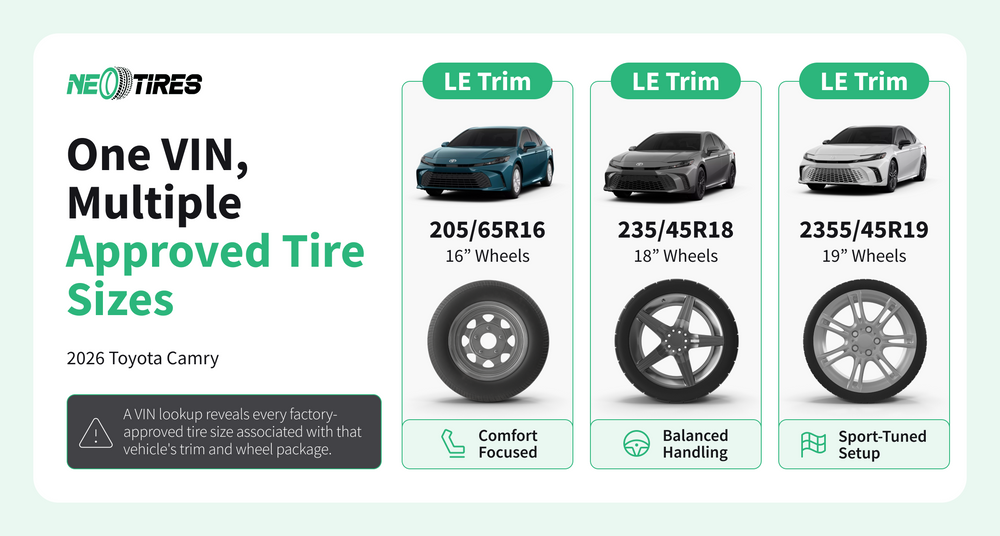
The variable is the trim level. Two vehicles sharing the same make, model, and year can require completely different tires if they sit on different trims - and the gap is often larger than drivers expect.
The 2025 Toyota Camry makes this concrete: the base LE trim ships on 16-inch wheels with 205/65R16 tires, while the top-trim XSE runs 19-inch wheels with 235/40R19 tires. Neither is correct for the other trim, and it's not just a size issue - the suspension on each trim is tuned around its intended tire. The XSE uses a lower-profile tire with a stiffer sidewall because the chassis was calibrated for sharper steering response. The LE uses a taller sidewall because ride comfort was the engineering priority. Swapping sizes between trims doesn't just risk fitment problems; it puts a tire on a chassis that wasn't designed around it.
Driving a Camry XSE? Confirm your 235/40R19 options. Right now: $15 off 2 tires, $20 off 4 tires, plus free shipping on anything you choose!
Beyond trim, many vehicles were sold with optional wheel packages at the time of purchase. That's why a VIN lookup for a single vehicle can legitimately return multiple valid sizes - all of them factory-approved for that specific car, depending on which package it left the factory with.
The 2020 Audi A6 55 TFSi quattro Advance is a real example. A VIN lookup for this vehicle returns six distinct OEM configurations:
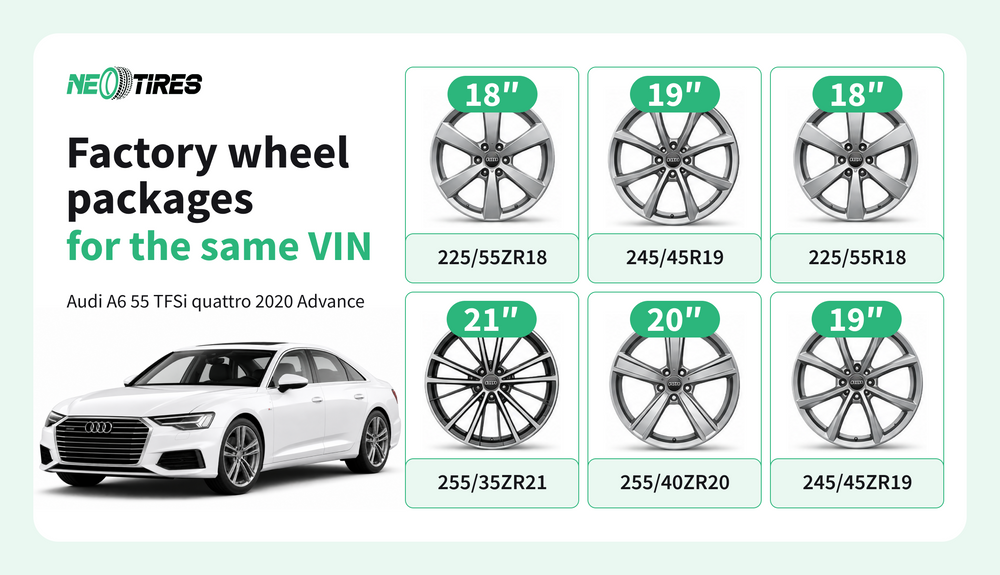
[Screenshot: NeoTires VIN search result for Audi A6 55 TFSi quattro 2020 Advance, showing six factory-certified configurations from 18" to 21" wheel diameter, each with front and rear axle illustrated]
All six sizes are correct for the 2020 Audi A6 55 TFSi quattro Advance vehicle. Which one applies to that specific car depends on the wheel package originally associated with that VIN.
What Staggered Fitment Means on Your VIN Lookup Result
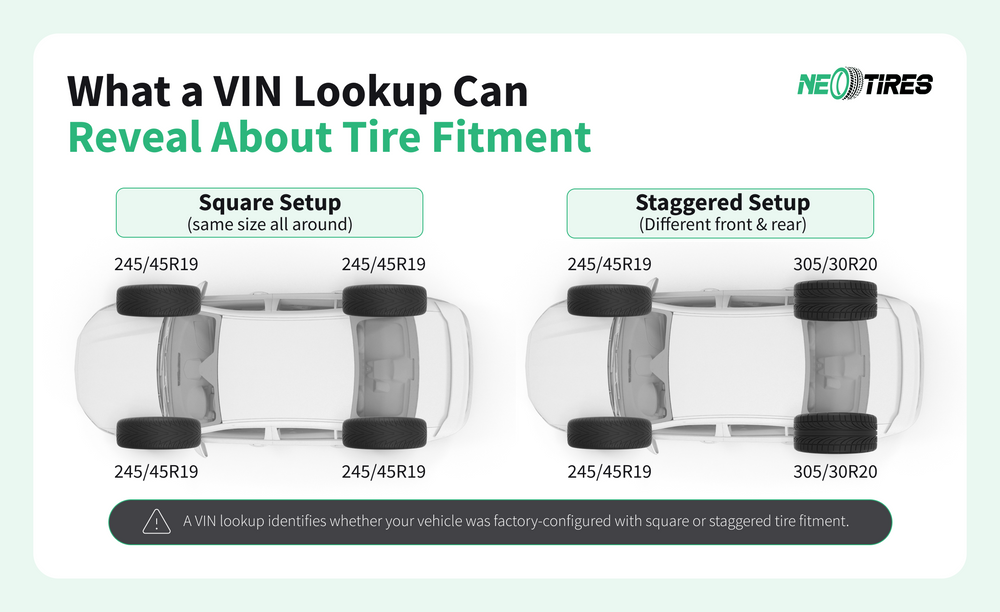
If your VIN lookup returns different front and rear tire sizes, your vehicle was factory-configured with staggered fitment. If the lookup returns the same size for all four corners, it was not, regardless of what's currently mounted on it.
Staggered fitment means the front and rear axles run different tire sizes from the factory, typically a narrower tire up front and a wider one at the rear. It's specific to rear-wheel-drive performance platforms where wider rear tires increase the contact patch at the driven wheels, improving traction during acceleration.
Factory staggered setups are found on BMW M cars, the GR Supra, Dodge Scat Packs, and dedicated sports cars like the Porsche 991.2 GT3 RS, which runs 265/35R20 front and 325/30R21 rear from the factory.
When your VIN lookup returns a staggered result, the front and rear sizes are listed separately. Buying the same size for all four corners on a factory-staggered vehicle changes the handling balance that the chassis was engineered around.
There are two practical consequences to know before purchasing tires for staggered vehicles. Because front and rear sizes differ, you usually can't rotate tires front-to-rear - only side-to-side on the same axle, if the tires are non-directional. This means rear tires typically wear faster and may need replacement sooner than the fronts. Some AWD vehicles also use factory staggered fitments, but all four tires must remain within the manufacturer's rolling-circumference tolerances. Exceeding those limits can create unnecessary drivetrain stress over time. Learn more about tire rotation in our dedicated guide.
How VIN Lookup Identifies Factory Tire Sizes
A VIN does not contain tire sizes directly. Instead, positions 4-8 of the VIN identify the vehicle's factory configuration, including details such as trim level and equipment package. Tire fitment databases use that information to determine which wheel and tire combinations were approved by the manufacturer. That's why two vehicles with the same make, model, and year can legitimately return different OEM tire sizes during a VIN lookup.
How to Read the Tire Size Your VIN Returns
Once you have your factory size returned by the VIN tool, the string of numbers and letters on the result follows a standard format. Taking 245/45R19 as an example:
Part | Value | What It Means |
Section width | 245 | Tire width in millimeters, measured from sidewall to sidewall |
Aspect ratio | 45 | Sidewall height as a percentage of the section width (45% of 245mm = ~110mm tall sidewall) |
Construction | R | Radial construction - the standard for passenger and performance tires |
Rim diameter | 19 | Wheel diameter in inches the tire is designed to mount on |
A speed rating and load index often follow - for example, 245/45R19 98W, where 98 is the load index (each tire rated to carry 750 kg / 1,653 lbs) and W indicates a maximum sustained speed rating of 270 km/h (168 mph). Your VIN lookup result will show whether your factory size carries a specific speed rating requirement, which matters when selecting replacements - the replacement should meet or exceed the OEM rating. The size string is only part of what's on the sidewall - DOT date codes, UTQG treadwear ratings, and load range markings are stamped there too; our guide to reading tire sidewall markings covers every code on the tire, not just the size.
Why VIN Fitment and Your Current Tires May Differ
VIN fitment and your current tires may differ because the VIN reflects the vehicle's original factory configuration, while the tires on the vehicle can be changed at any time. The size returned by a VIN lookup represents a manufacturer-approved fitment, not necessarily what's mounted on the car today.
Previous owners change tires. Dealers swap wheel packages. Aftermarket sizes get installed without updating any records. The door jamb sticker reflects the base factory configuration and doesn't update to reflect changes. Looking at the tire sidewall of a used car tells you what's on it today, not what it was designed to run.
This is why VIN lookup is more reliable than either the sticker or the tire sidewall when buying tires - it returns what the manufacturer certified for that chassis, independent of what anyone has done to the car since.
Why VIN Tire Lookup Matters Before Buying Tires
A VIN lookup helps confirm that you're buying a tire size approved for your vehicle's factory configuration. Without that verification, changes in tire diameter can affect speedometer accuracy, electronic driver-assistance systems, AWD operation, and transmission behavior. Because these effects often develop gradually and without warning lights, checking VIN fitment before purchase provides an additional layer of confidence beyond relying on the tire currently mounted on the vehicle.
Speedometer and Odometer Error
A tire size that doesn't match your VIN's OEM specification changes the circumference the speedometer was calibrated to. A tire 3% taller than OEM is enough to cause the speedometer to show 60 mph when actual speed is 63.3 mph - each rotation covers more ground than the system expects. The odometer drifts by the same ratio, skewing maintenance interval accuracy for daily drivers and creating untracked mileage overages on leased vehicles.
ABS and Stability Control Calibration
ABS and ESC intervention thresholds are set against the expected rotation rate of your factory tire diameter. A tire larger than what your VIN specifies rotates more slowly at any given road speed, causing both systems to read the vehicle as moving more slowly than it actually is. Large deviations from OEM tire diameter can alter the wheel-speed signals used by ABS and stability-control systems, potentially affecting how those systems interpret vehicle behavior.
Large deviations from OEM tire diameter can alter the wheel-speed signals used by ABS and stability-control systems, potentially affecting how those systems interpret vehicle behavior.
AWD Drivetrain Stress
AWD systems are engineered around equal rolling circumference across all four wheels - typically tolerating no more than 1-2% difference depending on the manufacturer. A tire that doesn't match the diameter your VIN confirms for that vehicle creates a continuous speed differential between axles that the transfer case and differential absorb every mile. The damage accumulates without warning until it becomes an expensive repair. Every size a VIN lookup returns maintains the rolling circumference the drivetrain was built around.
Transmission Shift Points
Shift points are calculated partly from wheel speed signals. A tire diameter that doesn't correspond to your VIN's OEM spec feeds the ECU incorrect rotation data, causing shift points to migrate - the transmission may upshift early under load or hold gears longer than intended. Like the other three systems, neither symptom surfaces as a warning light early on; Incorrect tire diameter can alter shift timing and drivability because the ECU receives wheel-speed information calibrated around the OEM tire size.
If you're considering a tire size other than what your VIN confirms as factory-approved, our guide to changing tire size safely covers the 3% rule, upsizing limits, and fitment guidelines in more depth.
Find Your Factory Tire Options by VIN
The tire size your car was designed to run isn't stamped anywhere on the VIN itself - but the VIN holds the configuration data that unlocks it. Trim level, factory option packages, staggered or square setup: all of it is encoded in positions 4-8, and a tire-specific lookup surfaces it in seconds. It's not a step you have to take every time you buy tires, but running it at least once while you own the vehicle gives you a reliable reference point for every purchase going forward.
Enter your VIN in the NeoTires search tool to see every factory-approved tire size for your exact configuration. If anything in the results is unclear or you're unsure which option fits your driving needs, reach out - we're here to help you make the right call.