


Most drivers see "LT" on a tire sidewall and assume it just means the tire fits a truck. It does - but that two-letter prefix carries a lot more weight than that.
LT tires are built differently from standard passenger (P-metric) or Standard Load (SL) tires from the casing up. Stiffer internal construction, higher recommended inflation pressures, and load ratings calibrated for towing, hauling, and serious off-road use - that's the short version of what separates them.
Here's where it gets practical: stiffer and stronger in an LT tire doesn't mean the right choice for every truck owner. Slap a set of LT tires on a half-ton you mostly use for commuting and school runs, and you'll likely notice a harsher ride, a small hit to fuel economy, and extra rotating weight - without ever using the added capacity you paid for.
But if you're regularly pulling a trailer, loading the bed, running a work vehicle, or pushing into rough terrain, LT tires earn their keep fast. The durability and towing stability difference over passenger tires is real and noticeable.
This article breaks down exactly what shifts when you move from a passenger tire to an LT - load ranges, inflation requirements, ride quality, winter behavior, longevity, and the misconceptions that lead a lot of buyers to over-tire or under-tire their trucks.
Table of Contents
- What Does LT Mean on a Tire?
- What Changes Between a P-Metric and an LT Tire?
- LT vs P-Metric Tires: Which Should You Choose?
- Are LT Tires Worth It?
- SL vs LT Tires: Which Should You Choose?
- Are LT Tires Really 10-Ply?
- Do LT Tires Need More Air Pressure?
- Are LT Tires Bigger Than Passenger Tires?
- Are LT Tires Heavier Than P Tires?
- Why Are LT Tires More Expensive?
- Do LT Tires Ride Rougher Than Passenger Tires?
- Are LT Tires Good for Highway Driving?
- Do LT Tires Last Longer Than Passenger Tires?
- Are LT Tires More Puncture Resistant?
- Are LT Tires Good in Snow?
- Are LT Tires Right for Your Vehicle?
What Does LT Mean on a Tire?
LT stands for Light Truck - and that's not just a vehicle classification, it's a completely different set of engineering standards.
Where a passenger tire (P-metric) is designed around comfort, fuel efficiency, and everyday road use, an LT tire is built for work. Higher load capacity, higher operating pressures, and construction tough enough to handle the kind of service conditions that would shorten the life of a standard passenger tire fast. The same size on the sidewall doesn't mean the same tire.
What Changes Between a P-Metric and an LT Tire?
An LT tire uses stronger internal construction than a comparable P-metric tire. Although a P265/70R17 and an LT265/70R17, for instance, may have nearly identical dimensions, the LT version is designed to support heavier loads, operate at higher inflation pressures, and withstand more demanding service conditions.
Take P265/70R17 and LT265/70R17 sizes as a real-world example. Mounted side by side, the differences in width and diameter are minimal. The distinction is found inside the tire. The LT265/70R17 typically carries a higher load rating, requires more inflation pressure to achieve its rated capacity, and is engineered to manage heat buildup more effectively during towing, hauling, and other heavy-duty applications.
The P-metric version is built for different priorities - comfort, lower weight, and everyday driving. Neither tire is better; they're engineered for different jobs - and if you're weighing P-metric against non-P fitments more broadly, the P vs non-P Tires guide goes deeper than most buyers expect.
LT vs P-Metric Tires: Which Should You Choose?
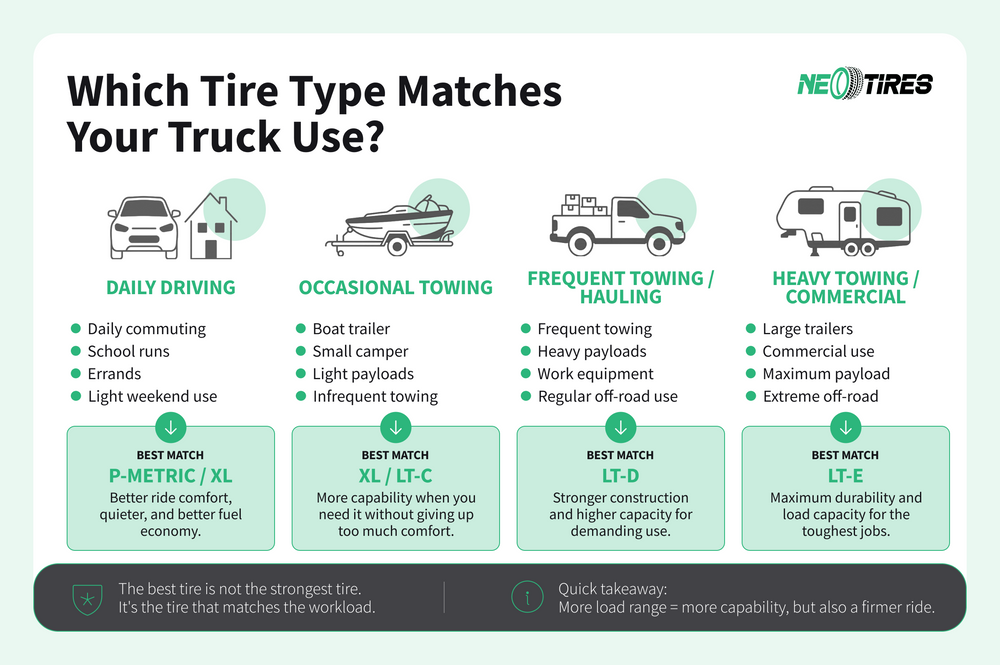
Choose LT tires if your truck regularly tows, carries heavy payloads, operates off-road, or sees commercial-duty use. For primarily unloaded daily driving, a P-metric or XL tire is often the better choice because it typically provides a smoother ride, lower weight, and improved fuel economy.
Two trucks running the same 265/70R17 size can have completely different tire needs. The one doing school runs and highway commutes has no real use for what separates a P265/70R17 from an LT265/70R17. The one towing, hauling, or running rough terrain regularly does - and that's exactly the gap in construction and load capacity that the LT version was built to fill.
The Ford F-150 is a good example of why tire construction should match the truck's original specification rather than assumptions. See our Ford F-150 Tire Sizes guide to compare the factory P-metric and LT tire combinations used across different generations and trims.
Are LT Tires Worth It?
For the right use case, absolutely. For the wrong one, you're paying more for a worse daily driving experience.
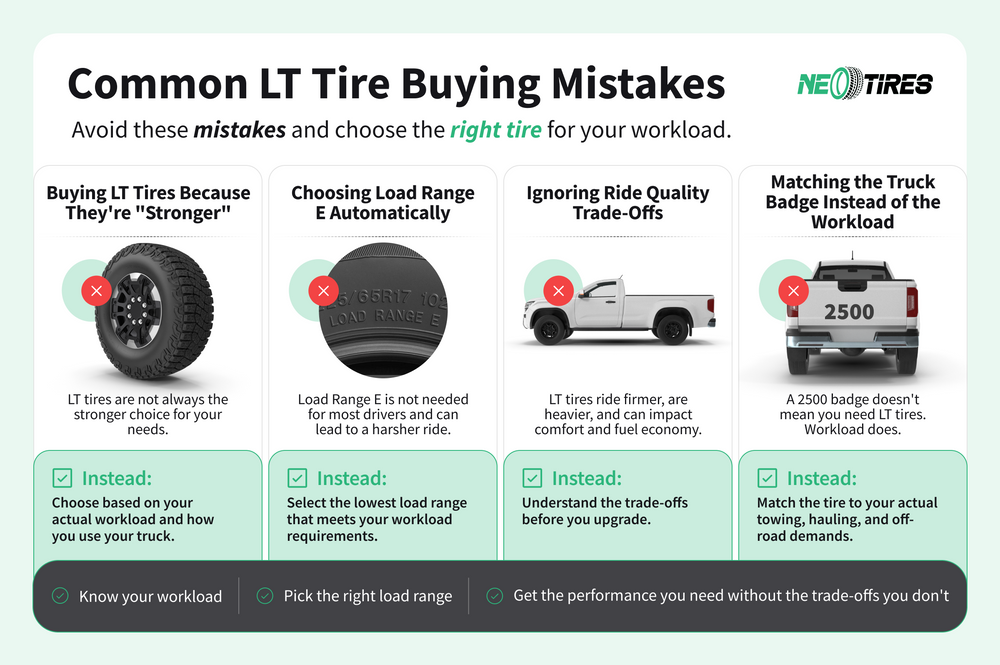
The deciding factor for an LT tire is workload, not the vehicle. A pickup truck badge doesn't automatically mean you need LT construction - and the fact that the Ford F-150, Ram 1500, and Toyota Tacoma all leave the factory on P-metric tires makes that point clearly. Manufacturers aren't cutting corners; they're matching the tire to how most half-ton owners actually use their trucks
Where LT tires earn their keep is under real load. Hook up a 7,000-pound travel trailer, fill the bed with gravel or equipment, or run the truck in demanding off-road conditions regularly - and the stability, heat resistance, and load rating margin of an LT tire starts making a genuine difference.
There's also a math element most buyers miss: P-metric tires carry a built-in 10% load capacity deduction when used on light trucks, so their real-world rating on a truck is lower than the sidewall number. Under heavy towing, that margin matters.
Run that same LT tire on a truck that mostly commutes unloaded, and the equation flips - firmer ride, extra rotating weight, higher cost, and none of the capacity being used. A quality P-metric, ST, or XL tire will ride better, likely last as long, and cost less in that scenario.
The honest answer: if your truck works for a living, LT tires are worth it. If it mostly drives you to work, they probably aren't.
SL vs LT Tires: Which Should You Choose?
For trucks that regularly tow, haul heavy cargo, run a camper, or work in demanding off-road conditions, LT is worth the upgrade. For most daily drivers, an SL (Standard Load) tire is the better call.
The core difference between SL and LT tires is load capability. SL tires are built around normal passenger and light-truck use; they prioritize ride comfort, lighter weight, and fuel efficiency. LT tires trade some of that comfort for stiffer construction and higher inflation pressures that can handle substantially more weight without breaking down under stress.
In practice, the decision comes down to what the truck is doing 80% of the time. A pickup that mostly commutes and runs errands will feel the LT's stiffness every single day without ever using the added capacity. That same truck hooked to a travel trailer every weekend is a different story - the stability, heat resistance, and load ratings start earning their keep fast.
A midsize SUV used for family driving and highway travel? SL or XL is the right direction. A one-ton hauling a slide-in camper through mountain passes? LT version is the right direction. Most buyers fall somewhere in between, and for them the honest answer is: match the tire to the load, not the vehicle badge.
LT vs SL Tires: Match the Tire to the Job
Use Case | Recommended |
Daily commuting, errands, highway driving | SL or XL |
Midsize SUV, family transportation | SL or XL |
Occasional towing or light hauling | SL XL or Load Range C |
Regular towing, loaded bed, work truck | LT Load Range D or E |
Slide-in camper, heavy trailer, mountain driving | LT Load Range E |
Commercial duty, demanding off-road | LT Load Range E |
Are LT Tires Really 10-Ply?
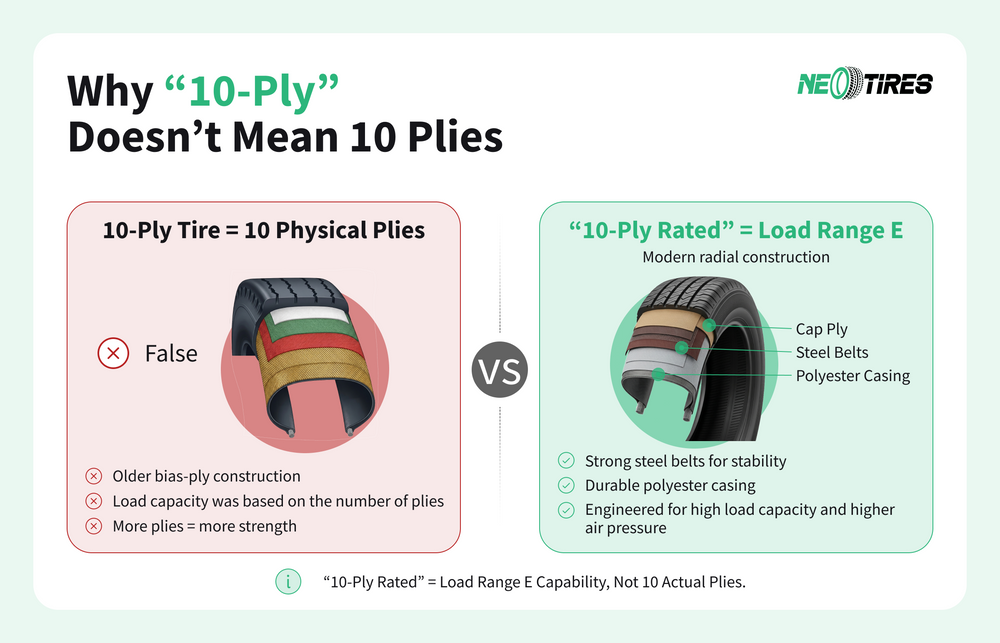
Usually, no - and the "10-ply" label causes more confusion than almost any other term in the tire category.
When drivers call an LT tire a "10-ply," they're usually referring to a Load Range E tire. The connection is historical: Load Range E was introduced to replace the load capacity once associated with ten-ply bias-ply construction. The name stuck. The actual plies didn't. Modern radial LT tires hit the same load ratings using significantly fewer physical layers and different construction methods altogether - typically two/three steel belts, a polyester casing, and sometimes additional cap plies - rather than anything close to ten stacked plies.
The confusion between "LT" and "10-ply" persists because the terminology is never fully updated to match the technology. Tire retailers, truck forums, and even some manufacturers still use "10-ply" as shorthand for Load Range E, which means buyers researching tires will run into both terms describing the exact same product. A Load Range E LT tire and a "10-ply" LT tire are the same thing - the difference is just the era the label came from.
So when you see "10-ply rated" on a product listing, it means Load Range E capability - not ten physical plies inside the tire.
Load Range C vs D vs E: Which One Do You Need in an LT Tire?
Load Range C, D, and E indicate how much weight an LT tire can carry and the pressure it needs to carry it. Each step up adds load capacity and construction strength - and also adds weight, stiffness, and inflation pressure requirements.
Load Range E is the most common and what most people picture when they think "LT tire," but it's not the right call for every truck.
Load Range C tops out around 50 PSI and works well for lighter half-tons, Jeeps, and SUVs that see moderate hauling or occasional off-road use.
Load Range D runs up to 65 PSI and is a common OEM spec on 3/4-ton pickups - it handles serious payload without going full heavy-duty. Load Range E reaches 80 PSI and is built for the heaviest towing, commercial use, and demanding off-road conditions where maximum durability matters.
A practical example: a half-ton pickup running LT275/65R18 tires mainly for commuting with occasional towing may have all the load capacity it needs from a Load Range C or D tire - with a noticeably more comfortable ride than Load Range E. Moving to E adds carrying capability, but if the truck rarely uses that capacity, the trade-off is a firmer ride and extra rotating weight with no real-world payoff.
The right load range is the one that matches what the vehicle actually does. Picking Load Range E because it's the highest rating is one of the most common ways truck owners end up over-tired - paying a ride quality penalty for capacity they never use.
Do LT Tires Need More Air Pressure?
Yes, and by a significant margin. Where a standard passenger SL tire maxes out around 35-36 PSI, a Load Range E LT tire can require up to 65-80 PSI to reach its rated load capacity - and that gap is what makes pressure management on LT tires more consequential than most drivers expect.
That higher pressure is what allows the LT tire to carry heavier loads without excessive heat buildup or sidewall deflection. But there's a catch most drivers don't know: run a Load Range E tire underinflated - below roughly 45 PSI - and it can actually carry less load than a comparable passenger tire. The heavier LT casing generates more internal heat through friction when underinflated, which undermines the load capacity advantage entirely.
The other distinction worth understanding is that maximum sidewall pressure and recommended operating pressure are not the same thing. A truck running LT tires doesn't automatically need 80 PSI on a daily commute. The right pressure depends on axle load, tire size, and what the vehicle is actually doing - a pickup towing a heavy trailer needs substantially more pressure than the same truck running empty.
For that reason, always set pressure according to the vehicle manufacturer's door placard and the tire manufacturer's load-inflation tables - not the maximum PSI molded into the sidewall.
Are LT Tires Bigger Than Passenger Tires?
No. LT tires are not automatically larger than passenger tires. The LT designation identifies a tire's service category and construction standards, not its physical size.
Take an LT265/70R17 as an example. Most tires in this size measure approximately 31.6 inches in diameter and 10.7 inches in width. A P265/70R17 uses the same dimensional sizing system and will usually measure almost identically. The difference is found in load capacity, inflation-pressure capability, and internal construction rather than overall size.
The confusion usually comes from the fact that many LT tires are sold in larger truck-oriented sizes. For example, 35X12.50R17, 37X12.50R17, and LT285/75R17 fitments are commonly purchased for lifted trucks, towing applications, and off-road use. As a result, drivers often associate LT tires with larger overall dimensions even though the LT designation itself does not increase diameter or width.
In practice, size and service category are separate decisions. A tire can be larger without being LT, and it can be LT without being larger. Always compare the actual size designation - such as 265/70R17, 285/70R17, or 35X12.50R17 - rather than relying on the LT marking alone.
Are LT Tires Heavier Than P Tires?
Yes. LT tires are typically heavier than comparable passenger tires because they use stronger casing materials, reinforced sidewalls, and additional structural components designed for higher load capacities. Depending on size and load range, an LT tire may weigh 5 to 20 pounds more than a passenger tire with the same dimensions.
A common example is the 275/65R18 size used on many full-size pickups. Passenger-rated tires in this size often weigh around 42 to 48 pounds, while an LT275/65R18 Load Range E tire commonly weighs 55 to 65 pounds, depending on tread design. Across a set of four tires, the LT version can add 40 to 60 pounds or more compared with a passenger-rated alternative.
That additional weight is one reason LT tires often feel different on the road. Heavier tires require more energy to accelerate and stop, and they increase unsprung weight, which can affect ride quality, suspension response, and fuel consumption. For this reason, many SUVs and lightly loaded pickups use XL-rated tires rather than LT tires unless additional load capacity is needed.
Why Are LT Tires More Expensive?
LT tires carry a higher price tag than comparable passenger tires, and the gap is real - typically ranging from 20% to 40% more depending on size and brand. That premium comes from what's inside: heavier-duty casing materials, reinforced sidewalls, and construction tolerances built around higher load ratings and inflation pressures. More material, stricter specs, higher manufacturing cost - it flows directly from what makes them LT tires in the first place.
A real example: an LT275/65R18 Load Range E all-terrain tire typically runs $20 to $60 more per tire than a passenger-rated equivalent in the same size. A passenger tire doesn't need to meet those standards, so it doesn't carry those costs.
Do LT Tires Ride Rougher Than Passenger Tires?
Generally, yes - and the gap can be bigger than most drivers expect.
LT tires run stiffer sidewalls and heavier internal construction than passenger tires, and that stiffness doesn't disappear on smooth highway pavement. It shows up on expansion joints, rough patches, and anything that asks the sidewall to absorb impact. With a passenger tire, the sidewall flexes and softens the hit. With an LT, less flex means more of that energy transfers to the cab.
The jump is sharpest when moving from a Standard Load or P-metric tire to an LT Load Range E. Drivers switching from a P275/65R18 to an LT275/65R18 Load Range E on a half-ton pickup often notice it immediately - especially if that truck spends most of its time unloaded on daily driving routes.
Here's the flip side: load the truck up or hook up a trailer, and the ride quality gap shrinks. An LT tire running near its rated capacity is doing exactly what it was designed to do, and the stiffness that felt excessively empty starts working in your favor - less sway, more planted feel, better stability through corners.
Are LT Tires Good for Highway Driving?
For the right truck, absolutely. If you're regularly towing, hauling, or running a loaded bed, LT tires hold up on highways better than passenger tires - less deflection, better heat resistance, more stable steering under weight. That's what they're built for.
The tradeoff shows up when the truck is empty. That stiffer LT tire sidewall that stabilizes a loaded trailer translates to a firmer feel on expansion joints and rough pavement when there's nothing in the bed - you'll feel it on a daily commute.
A useful way to think about it: put an LT-equipped pickup on a 400-mile highway pull with a 6,500-pound trailer and the tire's stiffness becomes an asset - less sway, more confidence, cooler running temps. Put the same truck on a suburban commute five days a week with an empty bed, and that same stiffness is just friction between you and a comfortable ride.
If towing and hauling are occasional rather than routine, a P-metric or XL tire will likely serve better on the highway day-to-day - and still handle the vehicle's load requirements without the ride penalty.
Do LT Tires Last Longer Than Passenger Tires?
Not automatically - and this is one of the more misunderstood things about LT tires.
Treadwear mileage comes down to tread compound, tire design, maintenance, and how the vehicle is actually used. The LT designation improves durability under heavy loads, towing, and off-road stress - but that doesn't translate into more miles in every situation.
Put an LT285/70R17 Toyo Open Country A/T III on a truck that tows a travel trailer several times a month, and the reinforced casing earns its keep - better heat management, less sidewall stress, more resistance to the kind of wear that cuts a passenger tire's life short under load. In those conditions, yes, the LT tire will likely outlast a passenger-rated equivalent.
Run that same LT tire on a half-ton that mostly commutes unloaded, and a good P-metric or XL highway tire will often match or beat it on treadwear mileage - because it was designed around exactly those lower-stress, everyday conditions.
The LT construction is built to last longer under the right workload. Match the tire to the use case, and longevity follows. Mismatch them, and you're paying for durability you're not using.
Are LT Tires More Puncture Resistant?
Generally, yes - and for off-road drivers, this matters as much as the load rating.
The reinforced casing and stiffer sidewall construction that give LT tires their load capacity also make them tougher against cuts, impacts, and punctures. Sharp rocks, trail debris, and rutted terrain put sidewall stress that passenger tires simply aren't built around - and that's where the LT construction shows its value most clearly.
It's a big reason why popular off-road tires like the Falken Wildpeak A/T4W and Cooper Discoverer AT3 XLT sell heavily in LT configurations. For a lot of off-road buyers, the puncture and sidewall protection is the actual selling point - the extra load capacity is almost secondary.
Are LT Tires Good in Snow?
Yes, LT tires can perform very well in snow, but winter traction depends on the tire's tread design rather than the LT designation itself. An LT tire built for winter or severe-service use may outperform many passenger tires in snow, while an LT highway tire without winter-focused features can struggle in the same conditions.
The LT marking simply indicates that the tire follows light-truck construction and load standards. It does not tell you how the tire will perform on snow or ice. Winter traction is influenced primarily by tread pattern, rubber compound, siping, and whether the tire carries the Three-Peak Mountain Snowflake (3PMSF) certification.
For example, LT tires such as the Falken Wildpeak A/T4W and General Grabber A/TX are available with 3PMSF certification and are commonly used year-round in regions that experience snow. By contrast, an LT highway tire designed primarily for dry pavement may offer limited winter capability despite having stronger construction.
When evaluating an LT tire for winter driving, the presence of the 3PMSF symbol is usually a more useful indicator of snow performance than the LT designation itself.
Are LT Tires Right for Your Vehicle?
By now, the pattern is clear: LT tires are the right call when the workload demands them, and the wrong call when it doesn't. The right tire isn't the strongest one available - it's the one that matches the actual job. If you're still deciding between passenger, XL, and LT construction with a specific load range, send us your tire size, vehicle, and how you use it. We'll help you find the right fit.