


Run-flat tires are tires that use reinforced sidewalls that support your vehicle's weight even with zero air pressure, allowing you to keep driving after a puncture for 50 miles more. While run flats can keep you driving to a safe location instead of stopping immediately on the side of the road on a flat tire, they come with both advantages and disadvantages related to ride comfort, cost, and long-term value that you should know about.
Most run-flat tires let you drive about 50 miles at speeds up to 50 mph with zero air pressure, which is their primary benefit [1]. This section outlines the eight benefits and nine shortcomings of run-flat tires to help you decide whether run flats are right for you. Let's take a closer look.
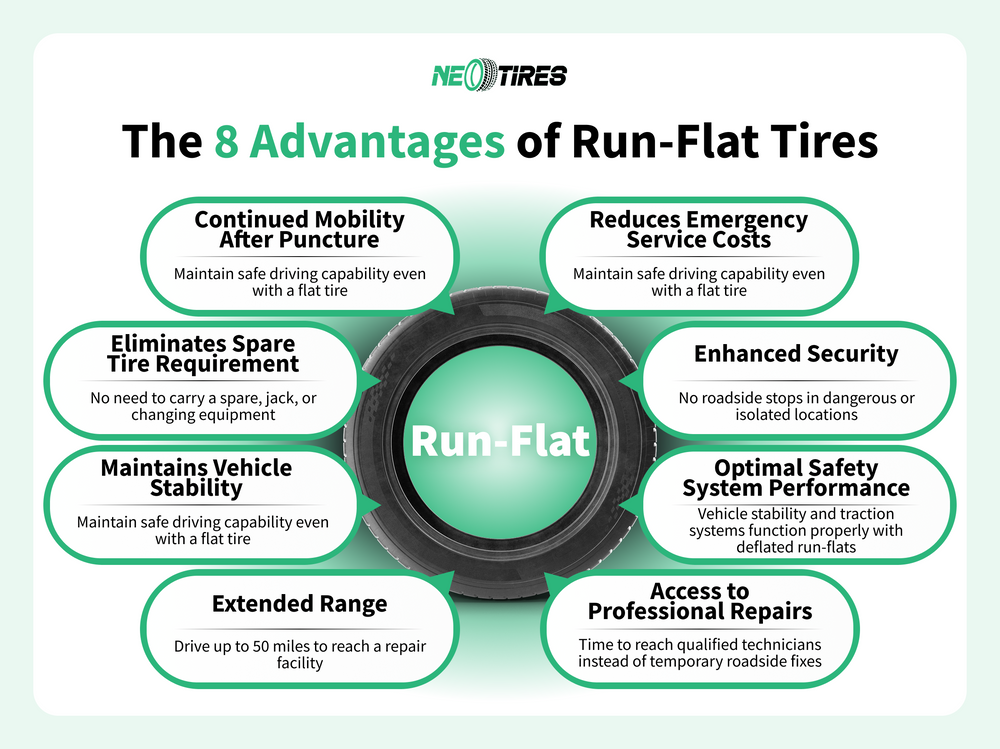
The 8 Advantages of Run-Flat Tires
1. You Can Keep Driving Safely After a Flat Tire
The biggest benefit of run-flat tires is preventing loss of control during tire failure. Unlike regular tires that can cause your car to swerve dangerously, run-flats maintain steering control and let you drive up to 50 miles safely to reach help. Here is how run-flats keep you safer:
- Your steering still works normally because the tire doesn't collapse off the wheel
- You're much less likely to have an accident during a tire failure
- You don't have to stop on highway shoulders to replace a tire yourself
With regular tires, when you suddenly lose air, you can lose control of your car. You might also end up stuck in a dangerous place, like a busy highway or a dark, empty road. Run-flat tires solve this problem by staying solid even without air.
According to the National Highway Traffic Safety Administration, about 11,000 tire-related crashes happen every year in the United States, with 563 deaths in 2022 alone [2]. Many of these crashes occur when drivers lose control after a tire failure.
2. You Don't Need a Spare Tire
Run-flat tires mean your car doesn't need to carry a spare tire, which saves weight and creates extra storage space.
The typical spare tire setup weighs 35-50 pounds, including the tire itself (25-35 lbs), the wheel (10-15 lbs), the jack (5-8 lbs), and the replacement tools (2-3 lbs). Getting rid of the tire replacement equipment gives you:
Weight savings:
- 35-50 pounds less weight in your car
- ≈ 0.2-0.3 MPG better fuel economy [3]
- Better handling because there's less weight to move around
Extra space:
- 2-4 cubic feet of additional storage room
- Underfloor areas become available for luggage or groceries
- Especially helpful in small cars and sports cars
3. Your Car Handles More Predictably When the Tire Goes Flat
Run-flat tires keep your car feeling relatively normal, unlike regular tires, which dramatically change how your car drives when they go flat.
The only thing supporting the vehicle on a totally deflated tire is the rim resting on the ground. Driving on a regular flat tire completely changes how your steering, brakes, and suspension work. Run-flat tires prevent this collapse.
How run flats behave when going flat:
- Your steering wheel retains approximately 70-80% of normal feel, even with zero air pressure
- Cornering is more stable due to stiff sidewalls, while a flat tire makes cornering risky due to loss of control
4. You Can Drive 50 Miles to Find Help
The 50-mile, 50-mph capability gives you enough range to reach a tire shop in most situations.
The 50-mile specific distance, agreed on by major tire makers including Bridgestone, Michelin, and Goodyear, means that in most cases, you can drive to a professional repair shop instead of changing the tire yourself or calling a tow truck.
What 50 miles gets you:
- In cities: Enough distance to reach several tire shops (usually a 45-60 minute drive)
- In suburbs: Usually covers the distance to the nearest town or service center
- On highways: Gets you to the next major exit or town (most interstate exits are 10-15 miles apart)
Of the 41% of drivers who experienced a flat tire in the last year, 28% changed the tire themselves, while 24% called roadside assistance [4] - circumstances in which a run-flat tire could have kept them safely moving. Yet, half of drivers said they aren’t familiar with run-flat tires [4].
5. You Save Money on Tow Trucks and Roadside Assistance
Run-flat tires reduce how often you need to call for help when you have tire problems. With run-flats, you:
- Reduce tire-related assistance
- Save an average of $50-350 per incident you avoid
- May not need to pay for comprehensive roadside assistance plans
According to AAA, flat tires are among the top reasons for roadside assistance calls, along with dead batteries and lockouts [5]. Calling for help typically costs:
- $50-$150 for a tire change if you don’t have a roadside assistance plan
- $150 to $350 for towing to a repair shop if you don’t have a roadside assistance plan
6. Better Safety in Dangerous Areas
Run-flat tires are especially valuable if you drive in areas where stopping could be risky. Run-flat technology helps in situations where stopping would expose you to danger:
Safety scenarios:
- High-crime neighborhoods: You can drive out of dangerous areas after getting a flat
- Remote locations: You avoid being vulnerable in isolated places
- Unfamiliar areas: You keep moving in places you don't know
7. Your Car's Safety Systems Work Better With Deflated Run-Flats
Run-flat tires allow your car's electronic stability control and traction control to keep working effectively even with a flat.
Modern cars use tire pressure monitoring systems (TPMS) connected to computers that control stability and traction. Run-flat tires keep the right size and shape for these systems to function:
Car system benefits:
- Electronic stability control stays more effective with deflated run-flats compared to regular deflated tires
- Your tire pressure warning system (TPMS) alerts you earlier before complete failure
- Anti-lock brakes can still modulate properly because the tire stays in contact with the road
8. Professional Tire Repair Instead of Quick Fixes
Run-flat capability ensures trained technicians fix/replace your tire using proper equipment. With run-flat tires, drivers are likely to gain the following repair benefits:
- Professional inspection finds internal tire damage you can't see from the outside
- Proper tire balancing and alignment checks during service
- Tire pressure monitoring system gets verified and adjusted
- Technicians identify related problems (wheel damage, suspension issues) that caused or resulted from the puncture
A study by Automotive Fleet found that fewer than 50% of American drivers know how to change a tire [6]. The 2024 Hankook survey notes that 24% of drivers called for roadside assistance when a flat tire occurred. In such circumstances, the run-flat technology allows the driver to reach a safe spot and have the tires professionally checked, repaired, or replaced.
9 Disadvantages of Run-Flat Tires
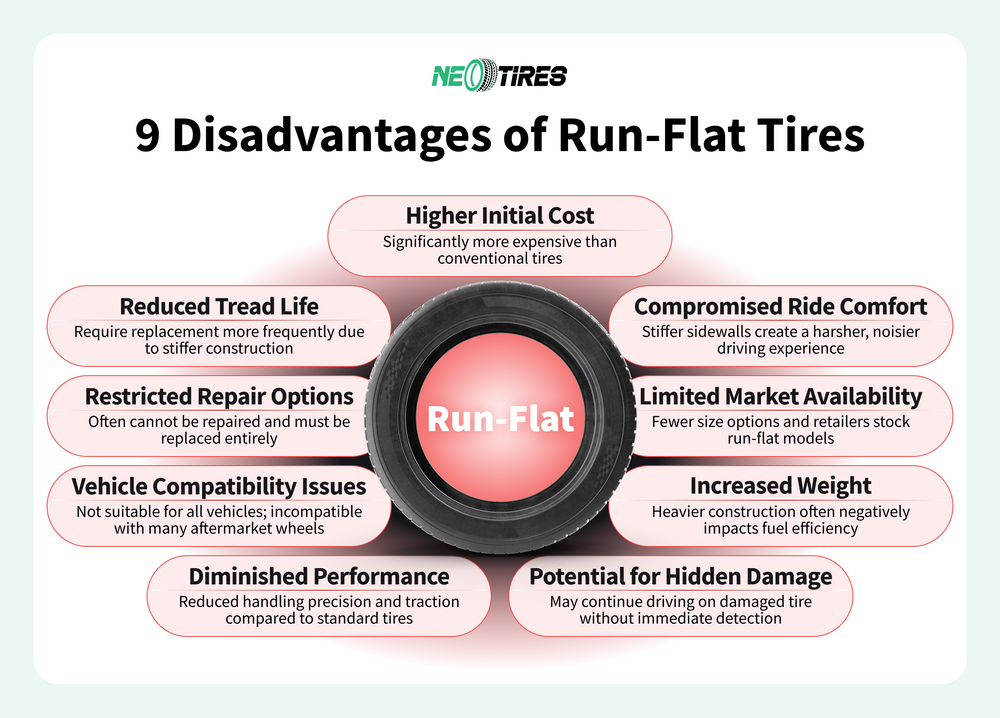
1. Higher Purchase Price
Run-flat tires cost ~25-50% more than similar regular tires, with some models nearly doubling the price. The price depends on the brand, tire model, and vehicle specifications. For example, the price of a run-flat Bridgestone tire for a 2016 BMW 328i ranges from $217 to $270; the average cost of a Bridgestone regular tire for a 2016 BMW 328i ranges from $171 to $217 per tire, a difference of 24%-27%.
However, the premium isn't uniform across all manufacturers. Research shows the difference can range from as little as 39 cents per tire for some Bridgestone models to over $50 per tire for specific Michelin options on the same vehicle, with a median difference of around $13.
2. Shorter Tire Life and More Frequent Replacements
Run-flat tires typically last 10-30% fewer miles than similar quality regular tires, and real-world data shows owners replace them much more often.
The stiffer sidewalls and harder rubber required for zero-pressure operation lead to faster tread wear in run-flat tires.
Life expectancy comparisons:
- Premium regular tires: ≈ 50,000-80,000 mile warranties
- Premium run-flat tires: ≈ 30,000-50,000 mile warranties
- High-performance regular: ≈ 30,000-45,000 miles
- High-performance run-flat: ≈ 20,000-35,000 miles
According to a J.D. Power study [7], run-flat tires wear out about 6,000 miles sooner than conventional tires on average. Long-term testing found average run-flat tread life was 42,300 miles versus 56,800 miles for equivalent regular tires, resulting in a 25.5% reduction.
Real-world replacement data from actual owners:
The comprehensive J.D. Power study tracking over 29,000 vehicle owners revealed significant differences in tire replacement rates:
Time Period | Run-Flat Owners Who Replaced Tires | Regular Tire Owners Who Replaced Tires | Difference |
First Year | 10% | 7% | 43% higher |
Second Year | 27% | 16% | 69% higher |
This means run-flat tire owners are 69% more likely to replace tires within two years, which translates to:
- More frequent tire replacements
- Higher yearly tire costs
- More tire disposal waste
- Greater overall ownership expense
Why do run flats wear faster?
- Harder rubber compounds wear quickly during normal driving
- Higher heat from less flexible sidewalls speeds up rubber breakdown
3. Rougher, Noisier Ride
The reinforced sidewalls that let you drive without air make the ride less comfortable.
Run-flat tires work more like structural parts than cushions. The stiffness required to support your car's weight without air pressure means they can't absorb bumps as well:
Comfort problems:
- Higher road noise inside your car
- Sharper impacts over bumps, potholes, and rough roads
- More vibration through your steering wheel and car body
- Less smoothing of minor road surface problems
Specific complaints:
Consumer surveys found that the majority of run-flat tire users said "harsher ride" was the most noticeable negative feature, including:
- Higher driver fatigue on long trips
- Potential passenger discomfort, especially in back seats
- Louder noise over coarse pavement
- "Bumpy" or "choppy" feeling over road joints and small imperfections
Some luxury car makers, including Mercedes-Benz and Lexus, have started offering regular tires as alternatives to run-flats on specific models, specifically because customers complained about the RFTs' lower ride quality.
4. Limited Repair Options - Usually Must Replace
Most run-flat tire damage requires buying a completely new tire instead of getting a simple repair.
Yokohama, Pirelli, and Continental recommend avoiding repair procedures on run flats, limiting drivers to one solution- tire replacement. Other manufacturers, including Bridgestone and Michelin [8], have strict repair rules for run-flat tires. For example, Michelin allows run-flat repair only once, following the same professional inspection and repair procedures as with regular tires.
5. Limited Availability of Run-Flat Tires
Run-flat tires are available in far fewer sizes and styles than regular tires. Market research highlights three core constraints:
- Higher cost: Run-flats usually carry a significant price premium, making many buyers opt for cheaper standard tires.
- OEM bias over aftermarket: Many run-flat models are installed as original equipment, limiting the breadth of options in the replacement market.
- Smaller player network: A relatively small number of major manufacturers actively support run-flat lines, creating fewer competing choices [9].
As a result, drivers often encounter:
- Narrower size and style selection
- Few run-flat options for trucks, SUVs, high-performance, or low-cost models
- Limited availability in small or rural tire shops
In markets with weak distribution, drivers may face days of waiting or be forced to drive long distances to find inventory.
6. Won't Work With All Cars and Aftermarket Wheels
Run-flat tires need specific car systems and wheel designs, limiting where you can use them.
Car system requirements:
- Must have TPMS: Run-flat tires need working tire pressure monitoring to warn you of air loss (you might not otherwise notice deflation)
- Special suspension: Suspension must be tuned for the extra tire stiffness
Potential aftermarket wheel problems:
Popular wheel modifications become difficult:
- Many aftermarket wheels aren't approved for run-flat tire use
- Wider-than-stock wheels may not properly hold run-flat tire beads
- Lightweight wheels, if not specifically engineered for the purpose, may lack strength for run-flat bead security
- Custom offsets, if not specifically engineered for the purpose, can interfere with run-flat tire clearances
BMW and Mini Cooper specifically warn against using non-approved aftermarket wheels with run-flat tires due to safety concerns [10]. If you’re considering switching to regular tires instead, our article “Can Run-Flat Tires Be Replaced With Regular Tires?” explains all the scenarios in detail.
7. Heavier Weight
While removing the spare tire reduces weight, the run-flat tires themselves weigh much more, often resulting in overall weight increases.
Weight comparison per tire (for size 225/45R17):
- Regular tire: ~18-22 lbs
- Run-flat tire: ~25-30 lbs
- Difference per tire: ~7-8 lbs
- Difference per four tires: ~28-32 lbs
Net weight math:
- Spare tire assembly weight saved: 35-50 lbs
- Four run-flat tires weight added: 28-32 lbs
- Net weight change: 3-22 lbs saved (or minimal addition in worst cases)
The problem is where the weight is:
- Spare tire weight was in the trunk/under the car (center)
- Run-flat weight is at the wheels (unsprung mass)
- Unsprung weight hurts suspension performance, acceleration, and handling much more
8. Worse Handling and Traction
The same sidewall stiffness that enables zero-pressure operation often reduces tire performance during normal driving.
Handling impacts:
- Less grip because the tire can't conform to the road as well as a normal tire
- Stiffer construction limits the tire's ability to adapt to road bumps and imperfections
- Less progressive warning when you're about to lose traction
- Less steering feel and road feedback
9. Risk of Undetected Damage and Sudden Failure
The ability to keep driving on deflated run-flat tires creates the risk of exceeding safe limits without knowing it. Unlike regular tires that immediately alert you through dramatic changes in handling and noise, run-flat tires maintain relatively steady operation. This creates the following risks:
- TPMS dependency: If the pressure warning system fails or you miss/ignore the warning, you may keep driving on deflated tires beyond the 50-mile/50-mph limits
- Progressive damage: Internal tire structure breaks down during zero-pressure operation; exceeding limits causes permanent damage
- Delayed failure: Tires may fail suddenly hours or days after zero-pressure driving if damage wasn't immediately apparent
Improper use risks:
Tire maker technical bulletins emphasize that exceeding run-flat specifications causes:
- Internal ply separation, invisible from the outside
- Sidewall structural failure at the molecular level
- Bead area damage compromising the tire-wheel seal
- Heat buildup leading to rubber breakdown
Pros vs Cons of Run-Flat Tires: Summary Table
The table below shows the benefits and drawbacks of run-flat tires reported by real-world drivers, industry tests, and manufacturers' reports:
Run Flat Tire Pros (8 Key Benefits) | Run Flat Tire Cons (9 Key Drawbacks) |
|---|---|
1. Let you keep driving safely for up to 50 miles after a puncture. | 1. Cost ≈ 25–50% higher than regular tires. |
2. Eliminate the need for a spare tire, saving space and some weight. | 2. Shorter tread life – about 10–30% fewer miles. |
3. Maintain steering control and handling when deflated. | 3. Harsher, noisier ride due to stiff sidewalls. |
4. Reduce roadside stops and towing costs. | 4. Usually must be replaced – limited repair options. |
5. Provide better safety in dangerous or remote areas. | 5. Limited availability and fewer size options. |
6. Keep ABS, traction, and stability systems functional when flat. | 6. Not compatible with all vehicles or aftermarket wheels. |
7. Ensure professional repair and inspection at service centers. | 7. Heavier tire weight adds unsprung mass, possibly reducing efficiency. |
8. Offer peace of mind for safety-focused or urban drivers. | 8. Slightly reduced handling and traction under normal driving. |
| 9. Risk of hidden damage if driven too long deflated. |
Should You Get Run-Flat Tires? Decision Guide
Considering all advantages and disadvantages of run-flat tires, Run flats make sense for drivers who:
- Put safety and security above comfort and cost
- Often drive in high-risk areas (urban, remote)
- Have physical limitations preventing tire changes
- Drive vehicles where cargo space is critical
- Accept ~25-50% higher tire costs
- Can tolerate noticeably rougher ride quality
Run-flat tires are a poor choice for drivers who:
- Prioritize ride comfort and refinement
- Take a budget-conscious approach to car costs
- Drive in areas with limited tire service access
- Want maximum tire performance (handling, braking, traction)
- Need specific tire types (winter, off-road, performance track)
- Modify vehicles with aftermarket wheels or suspension
Final Thoughts: Safety vs. Practical Trade-offs
Run-flat tires represent a real safety advancement, virtually eliminating the dangers of tire failure. The ability to drive 50 miles after complete air loss provides measurable benefits in accident avoidance, personal security, and convenience.
However, these benefits come with substantial costs, both financial (higher buying and maintenance costs) and experiential (rougher ride, reduced performance, limited selection). The decision depends on your individual priorities: whether safety and convenience outweigh comfort, cost, and performance for your specific situation.
For urban drivers in newer cars designed for run-flat tires, the advantages often justify the disadvantages. For budget-conscious drivers, performance enthusiasts, or those in areas with limited tire service access, regular tires with good roadside assistance coverage may provide better overall value.
References:
[1] Bridgestone. "Run-Flat Technology."
https://www.bridgestone.com/technology_innovation/run-flat_tire/
[2] National Highway Traffic Safety Administration
https://www.nhtsa.gov/vehicle-safety/tires
[3] MDPI. “Strategies for Reducing Automobile Fuel Consumption”.
https://www.mdpi.com/2076-3417/14/2/910
[4] Hankook Tire. “Hankook Tire’s Gauge Index: Driver Survey Results”
[5] AAA. “Spare tire alternatives often fall flat”
https://www.ace.aaa.com/publications/auto/drive-smart/disappearing-spare-tire.html
[6]Automotive Fleet.” Less Than 50% of American Drivers Know How to Change a Tire”
https://www.automotive-fleet.com/10245052/less-than-50-of-american-drivers-know-how-to-change-a-tire
[7] J.D. Power Report: “Run-Flat Tires Letting Air Out of Customer Satisfaction”
[8] Manufacturer technical bulletins from Bridgestone, Michelin, and other run-flat tire manufacturers
[9] Cognitive Market Research. “Run-Flat Tire Market Report”
https://www.cognitivemarketresearch.com/run-flat-tire-market-report
[10] BMW/Mini Cooper owner's manuals and technical service bulletins regarding wheel specifications