


Tire tread designs are vital for safety, performance, and efficiency. Whether on wet highways or snowy backroads, the interaction between a tire and the road surface affects grip, stopping distance, handling, and even fuel consumption. Knowing what tire tread patterns exist, how they vary, and which one fits your driving conditions is crucial for every driver seeking confidence on the road.
In this guide, we outline the primary tread patterns: symmetrical, asymmetrical, directional, and off-road. This article also discusses how tread patterns influence traction, noise levels, and fuel efficiency, and offers practical advice on selecting the appropriate design for your vehicle and driving environment. By the end, you will have a comprehensive understanding of tire tread designs, including siping and blocks, and which designs best suit your needs for rain, off-road, or snow.
- What Are Tire Tread Patterns?
- Why Tread Patterns on Tires Are Important
- Types of Tire Tread Patterns
- How Tread Patterns Influence Driving Performance
- Recommended Tread Patterns Based on Driving Conditions
- Bottom Line
What Are Tire Tread Patterns?
Tire tread patterns are the arrangement of grooves, blocks, ribs, sipes, and voids on the tire surface. This arrangement affects how a tire interacts with the road, influencing traction, braking, water displacement, noise, and comfort. A well-designed tread pattern helps the tire maintain grip in different conditions, channels water effectively to prevent hydroplaning, and provides stability during cornering and braking.
Key Elements of a Tire Tread
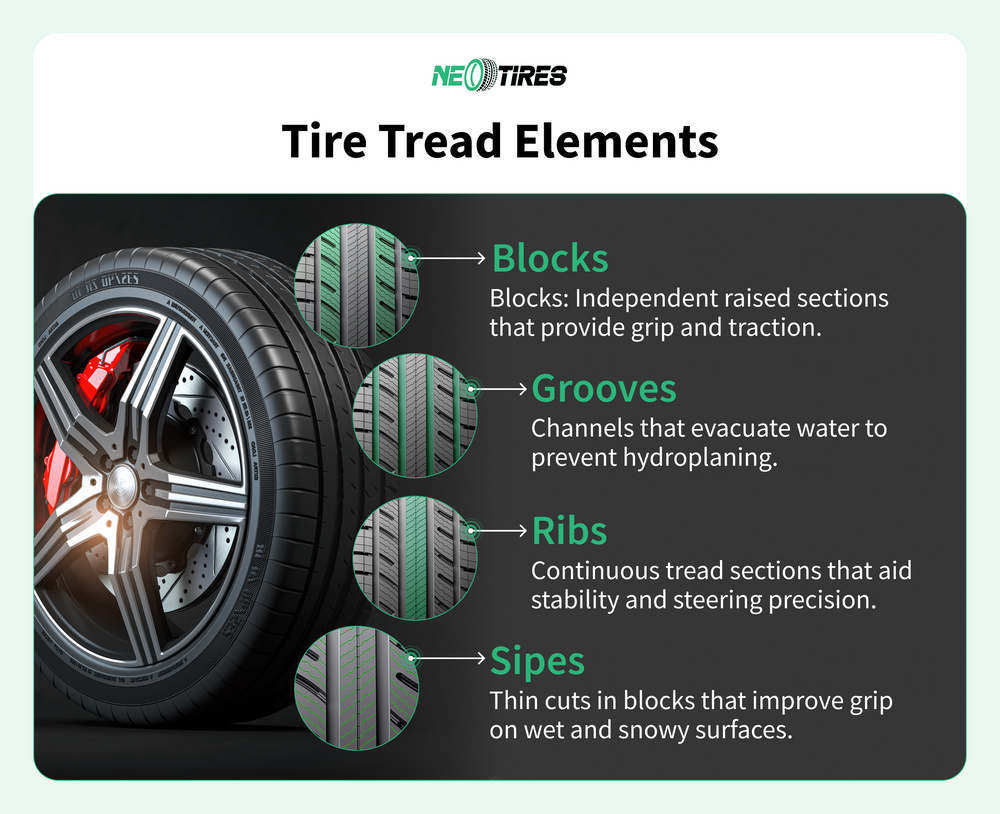
A tire’s performance is largely determined by the design of its tread, not just by its size or rubber compound. Tire tread patterns are composed of multiple elements: tread blocks, ribs, grooves, and sipes, each designed to address specific driving challenges. These elements work together and can provide insights into why some tires excel in dry conditions, while others are optimized for wet roads, snow, or off-road terrain. Here is the breakdown on tire tread elements:
Tread Blocks
Tread blocks are the raised rubber sections that contact the road. Bigger and sturdier blocks enhance traction on dry surfaces, improve cornering stability, and boost braking efficiency.
Conversely, smaller, more flexible blocks offer improved grip on wet and snowy roads. The configuration and dimensions of these blocks also influence road noise; tires with uniformly shaped tread blocks can produce a whining sound (harmonic noise). To minimize noise, manufacturers often design tires with blocks of varying shapes and sizes (called "pitch sequencing") to produce noise at different frequencies that cancel each other out, making it less noticeable.
Ribs
Tire ribs are rows of connected tread blocks that run around the tire. Ribs help maintain straight-line stability, lower rolling resistance, and improve fuel efficiency. Tires with continuous ribs, such as touring all-season tires, typically produce less road noise and offer a smoother ride.
Grooves
Grooves are channels that remove water, slush, or mud from the contact patch. Wide circumferential grooves, commonly seen on tires, improve wet traction, while lateral grooves enhance performance in snow and mud. The depth, angle, and number of grooves directly affect hydroplaning resistance.
Sipes
Sipes are tiny slits found in the tread blocks that enhance grip by providing additional biting edges, which is especially beneficial on wet or icy surfaces. Winter tires may feature thousands of sipes to improve traction on snow and ice. This design element helps to reduce braking distances and improve cornering performance, especially in cold conditions.
Why Tread Patterns on Tires Are Important (Safety, Grip & Efficiency)
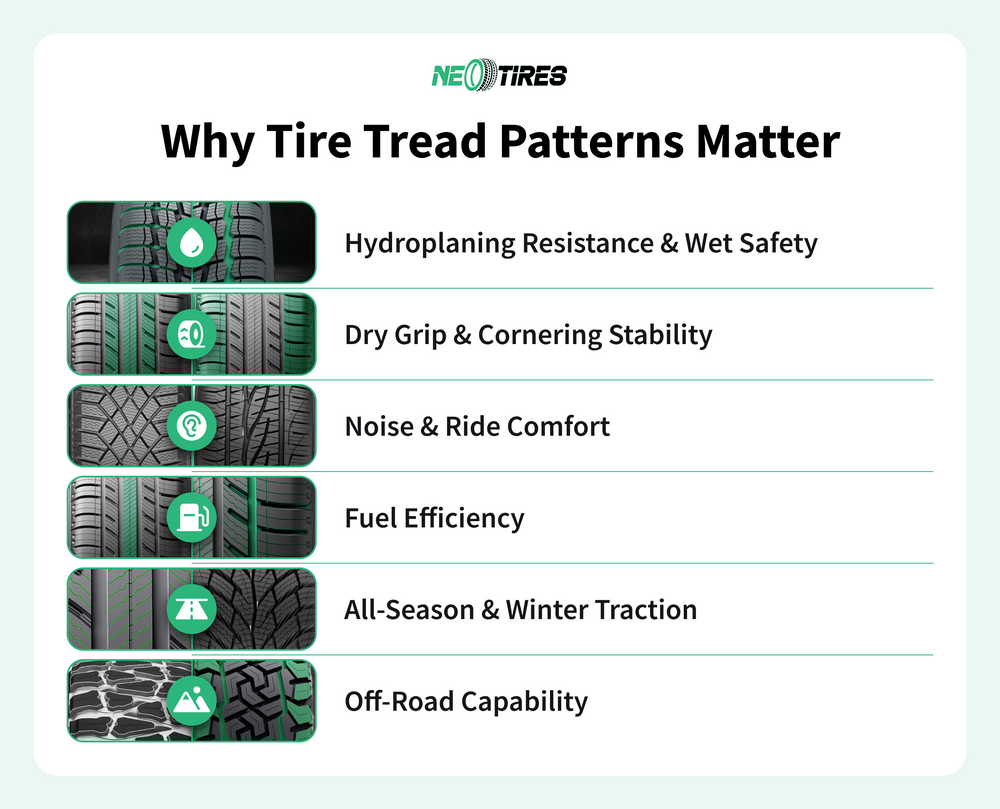
Tire tread is not merely an aesthetic design etched into the rubber; it serves as the main connection between your vehicle and the road. The configuration, shape, and arrangement of blocks, ribs, grooves, and sipes dictate how a tire performs in real-world driving situations. Even slight variations in tread design can significantly influence traction, safety, and handling. Here’s why tread patterns hold such importance:
Hydroplaning Resistance & Wet Safety
The broad grooves and lateral channels within a tread work to channel water away from the contact patch. A tread design optimized for effective water flow:
-lowers the likelihood of hydroplaning
-maintains steering control during intense rainfall
-reduces wet braking distances
Directional and asymmetrical patterns usually excel in these conditions.
Dry Grip & Cornering Stability
The rigidity and configuration of tread blocks impact a tire's grip on dry surfaces during acceleration, braking, and sharp turns. High-performance patterns often employ:
-larger shoulder blocks
-reinforced ribs
-fewer deep voids to enhance road contact and ensure maximum stability.
Noise & Ride Comfort
Tread patterns affect the amount of air that is compressed and released as a tire rolls. Optimized designs (typically symmetrical or asymmetrical):
-reduce harmonic noise
-provide a more comfortable ride
-enhance cabin sound quality.
Fuel Efficiency
The greater the tread flex, the higher the tire's energy consumption. Patterns engineered specifically for low rolling resistance often use:
-continuous ribs
-smaller voids
-limited movement of tread blocks.
These features minimize energy loss and improve fuel efficiency.
All-Season and Winter Traction
Sipes and specially shaped blocks generate numerous tiny biting edges. These configurations enhance:
-grip on light snow
-traction on slush
-braking on icy or slick surfaces.
Off-Road Capability
Deep, aggressive voids and open-shoulder designs enable off-road treads to:
-dig into mud and loose terrain
-self-clean rapidly
-maintain stability on uneven ground.
The appropriate tread pattern serves as the cornerstone of safety, efficiency, and performance. It dictates how your vehicle confidently navigates every type of road condition.
Types of Tire Tread Patterns
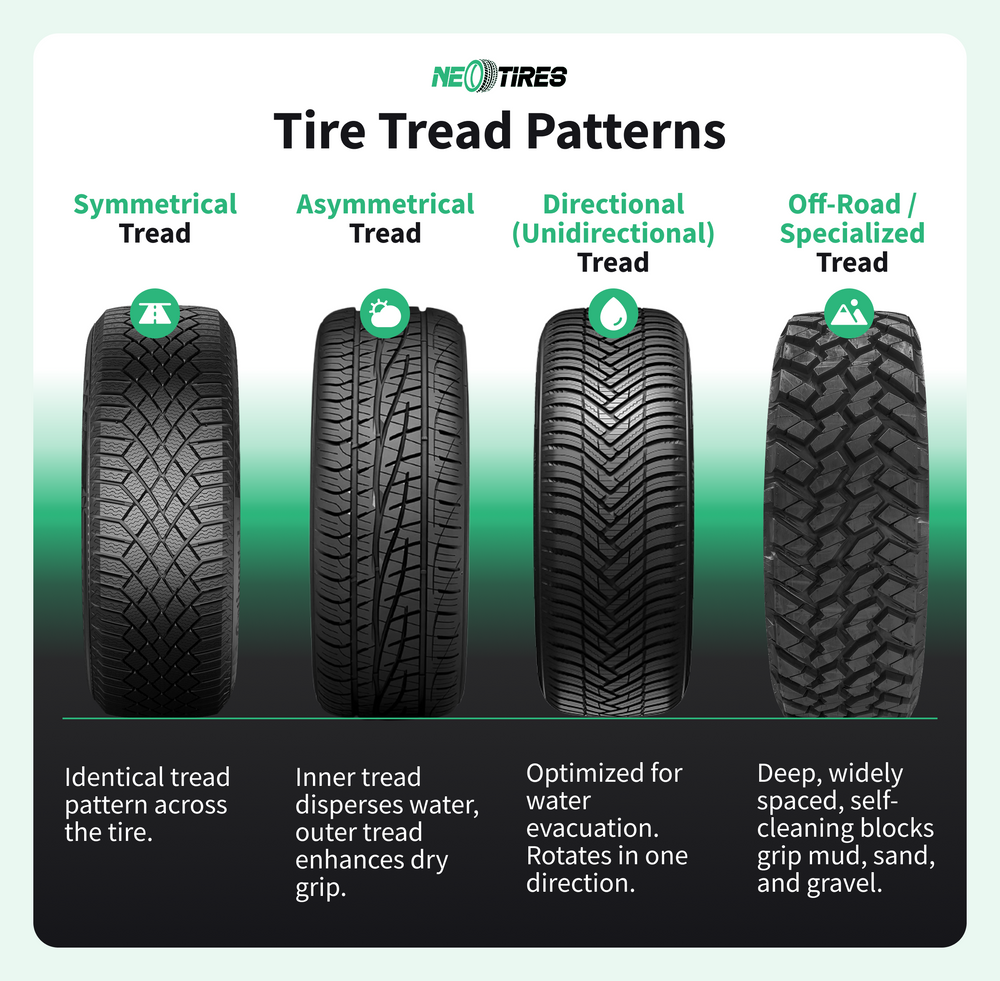
Broadly, tire tread patterns fall into four categories: symmetrical, asymmetrical, directional (unidirectional), and off-road/specialized patterns. Each type has a unique combination of tread blocks, grooves, ribs, and siping, which makes it better suited for certain conditions, be it dry, wet, snowy, or off-road surfaces.
Symmetrical tires offer consistent wear and quiet operation; asymmetrical tires balance wet and dry performance; directional tires focus on water evacuation and high-speed stability; and off-road patterns maximize grip in mud, sand, and gravel. Here is the breakdown of each pattern in detail:
Symmetrical Tread: Specs, Pros, Cons, Examples
Symmetrical patterns are ideal for commuter vehicles or daily driving, where consistent performance and low maintenance are key.
They perform best in dry and mildly wet conditions on paved roads, making them ideal for city driving and highway cruising. Common examples of tires with a symmetrical design include the Goodyear Assurance All-Season and the Continental TrueContact Tour.
Characteristics
Symmetrical tires have identical tread patterns across the entire tire surface, meaning the tread blocks, grooves, and ribs mirror each other. This structure maintains consistent road contact, ensures even wear, and produces low rolling resistance. Tires can be rotated front-to-back or diagonally, which makes them easier to maintain and extends their lifespan.
Advantages
- Smooth, quiet ride with minimal vibration
- Long-lasting due to even wear
- Cost-effective and widely available
Disadvantages
- Limited high-performance handling in aggressive cornering
- Less traction versatility in wet or extreme conditions
Asymmetrical Tread: Specs, Pros, Cons, Examples
Asymmetrical patterns provide a balance between wet traction and dry-road handling. They are suitable for all-season driving and high-performance vehicles, offering versatility across multiple conditions. Common examples of tires with asymmetrical design include Continental ExtremeContact DWS 06+ and Bridgestone Turanza QuietTrack.
Characteristics
Asymmetrical tires feature different tread designs on the inner and outer edges. The inner tread focuses on water dispersion and wet traction, while the outer tread enhances cornering stability and dry grip. Sipes may improve traction in light snow or icy conditions, making the tire versatile across varied weather.
Advantages
- Balanced performance in wet and dry conditions
- Enhanced steering response and cornering stability
- Some models offer light snow traction
Disadvantages
- Often higher cost compared to symmetrical tires
- Must be mounted correctly (inside/outside) to achieve optimal performance
Directional (Unidirectional) Tread: Specs, Pros, Cons, Examples
The directional design optimizes water evacuation, high-speed stability, and winter slush handling. This pattern type performs best in wet or slushy conditions and at higher speeds on highways, making it ideal for performance driving and winter or rainy-weather scenarios. Common examples of tires with directional design include Michelin Pilot Sport 4S and Nokian Hakkapeliitta R5.
Characteristics
Directional tires often feature a V-shaped or Arrow-shaped tread pattern designed to rotate in a single direction. Grooves and tread blocks are angled to channel water away, reducing the risk of hydroplaning efficiently. This tread type is often found in performance vehicles and winter tires that require consistent high-speed traction.
Advantages
- Excellent wet-weather traction and hydroplaning resistance
- Maintains stability at high speeds
- Improved handling in snow or slushy conditions
Disadvantages
- Rotation is limited to front-to-back on the same side of the vehicle
- Slightly higher road noise on dry pavement
Off-Road / Specialized Tread Patterns: Specs, Pros, Cons, Examples
The tread pattern of off-road tires is often aggressive and highly pronounced, featuring large, widely spaced tread blocks, deep grooves, and rugged lugs. This design helps the tire grip mud, sand, gravel, and rocky surfaces, while the wide spacing of the tread blocks expels debris, maintaining traction. Common examples of tires with off-road/ specialized tread patterns include BF Goodrich All-Terrain T/A KO2 and Toyo Open Country RT Pro.
Characteristics
Off-road tread patterns often incorporate variable tread block shapes, multi-depth grooves, and reinforced sidewalls to optimize traction on different surfaces. The block orientation and groove width are engineered to improve bite on loose terrain, channel mud and water, and resist tearing or chipping. These tires often include stone ejectors and siping on certain blocks to enhance grip on rocks and wet surfaces.
Advantages
- Exceptional traction on mud, sand, gravel, and rocky terrain
- Self-cleaning tread design maintains performance in debris-filled environments
- Reinforced sidewalls improve durability against cuts, punctures, and impact
Disadvantages
- Higher road noise compared to highway-focused tires
- Increased rolling resistance reduces fuel efficiency
- Off-road patterns can be harsh and less comfortable on paved roads
- Not optimized for high-speed highway performance
How Tread Patterns Influence Driving Performance
Different tire tread patterns directly determine how a vehicle behaves in real driving conditions, how it grips, brakes, and handles hydroplaning. For example, symmetrical tires provide stable grip on dry and lightly wet roads but may underperform in heavy rain due to limited water evacuation features. Asymmetrical tires balance wet and dry traction, with stronger cornering than symmetrical patterns, though they require proper mounting to perform optimally.
Directional tires excel at high-speed stability and hydroplaning resistance but can be slightly noisier and have limited rotation options. Off-road-specific patterns deliver exceptional traction in mud, sand, gravel, and rocks but generate more noise and are less efficient on paved surfaces. Learn more about Choosing the Best Off-Road Tires: The Ultimate Guide dedicated article.
That’s why evaluating your usual driving conditions is essential before selecting a tire with a particular tread pattern.
Performance Comparison of Tire Tread Patterns
The table below shows how each major tire tread pattern actually behaves on the road, focusing on traction, braking, hydroplaning resistance, and ride comfort. It highlights the strengths and limitations of each type under different driving conditions, allowing you to quickly compare performance without delving into technical design details.
Tire Tread Pattern | Traction & Grip | Braking Performance | Hydroplaning Resistance | Noise & Comfort |
Symmetrical | Consistent grip on dry roads; adequate in light rain but less stable in heavy wet conditions compared to directional or asymmetrical tires | Reliable dry braking; wet braking distances longer than directional or hybrid tires | Limited; prone to hydroplaning in heavy rain | Often very quiet; smooth ride with minimal vibration |
Asymmetrical | Balanced grip on wet and dry roads; corners more firmly than symmetrical tires; performs moderately in light snow | Wet braking is better than symmetrical; dry braking is strong due to stiff outer blocks | Moderate; inner tread channels water to reduce skidding | Slightly more road noise than symmetrical; still comfortable |
Directional (Unidirectional) | Strong grip at high speeds; excels in wet conditions; more precise cornering than symmetrical or asymmetrical tires | Shorter stopping distances on wet surfaces; dry braking is solid but slightly less smooth than asymmetrical tires | High; evacuates water from the contact patch effectively | Slightly louder than symmetrical due to angled tread |
Off-Road / Specialized | Exceptional off-road grip in mud, sand, gravel, and rocks; lower pavement traction than on-road patterns | Longer braking distances on paved surfaces due to irregular contact | Low on wet asphalt; the hydroplaning risk is higher than on-road patterns | Noisy on asphalt; rough ride off-road acceptable |
*These performance characteristics reflect general behavior associated with each tread pattern. Actual results may vary depending on tire brand, vehicle type, tire age, inflation, load, and driving conditions.
Recommended Tread Patterns Based on Driving Conditions
Each driving situation requires a tire tread pattern optimized for specific performance characteristics. For example, wet environments require tires that drain water well, such as V-shaped tires; dry, high-speed driving prefers tread patterns that ensure stability and precise cornering, such as symmetrical designs.
Snowy or icy conditions generally benefit from patterns with more siping and better snow channeling. Off-road driving requires aggressive tread blocks for optimal grip on loose or uneven surfaces.
Table | Tread Patterns & Models for Different Driving Conditions
The table below offers a clear overview of suggested tread patterns for common driving situations, along with all-season tire examples (and winter models for winter conditions) in different price ranges:
Driving Condition | Recommended Tread Pattern | Tire Examples (Affordable →Mid Budget→ Premium) |
Daily urban commuting (dry/light rain) | Symmetrical | Continental TrueContact Tour→Goodyear Assurance AS → Pirelli Scorpion Zero |
Mixed urban/suburban (wet + dry) | Asymmetrical | Goodyear Assurance WeatherReady→Continental ExtremeContact DWS06 Plus →Pirelli P Zero All Season Plus |
Wet highways / heavy rain | Directional | Hankook Kinergy 4S2 H750→Toyo Proxes ST III→Pirelli Cinturato WeatherActive |
Off-road trails / unpaved terrain | Off-Road / Specialized | Falken Wildpeak A/T (all terrain); Yokohama Geolandar M/T G003 (mud terrain); Toyo Open Country R/T Pro (rugged terrain) |
Snowy/icy roads | Directional with siping, or studdable tread | Toyo Observe GSi-6 HP→General Altimax Arctic 12→Nokian Hakkapeliitta R5 |
Overview of Recommended Tread Patterns
Symmetrical tread for daily city commuting (dry/light rain): Provides reliable traction and a quiet ride on paved surfaces; however, its limited water evacuation can complicate driving in heavy rain.
Asymmetrical tread for mixed urban/suburban driving (wet + dry): The inner grooves effectively channel water, while the outer tread enhances cornering performance. Proper mounting is essential.
Directional pattern for wet highways / heavy rain: The V-shaped tread design is the best in removing water, minimizing the risk of hydroplaning, and enhancing stability at high speeds.
Off-road pattern for off-road / unpaved terrain: Features aggressive tread blocks and deep grooves that enhance traction on loose surfaces while having a self-cleaning capability to remove debris.
Need serious off-road capability? Confirmed in stock. Right now: $15 off 2 tires, $20 off 4 tires, with promocode at checkout, plus free shipping:
- Toyo Open Country R/T Pro, rated 5 stars, from $337.13 per tire
Directional pattern with siping for snowy or icy roads: Effectively bites and channels snow and slush. Studdable/studded tires for severe winter conditions are recommended, if the local laws allow. Check out the Studded Tires Guide 2025: Laws, Benefits, and Performance Review for more insights on studded tires.
Driving Performance Starts at the Tread Pattern
When choosing tires, it's important to grasp the science, engineering, and practical performance associated with tread patterns. The designs: symmetrical, asymmetrical, directional, and off-road - are not random; they are meticulously crafted to enhance traction, facilitate water and snow drainage, minimize noise, improve handling, and increase fuel efficiency.
At NeoTires, we emphasize both expertise and experience: all our recommendations are based on manufacturer data, industry standards, and verified field testing. Reach out to us if you're unsure which tread pattern suits you best; our trained team will guide you based on your needs, climate, and driving conditions. Or explore our catalog to find tires tailored to your needs at affordable prices and enjoy fast shipping across the U.S. Drive safely!
Resources:
Michelin |Technical Tire Guides
Continental Tires |Technical Info
Nokian Tires |Technical Articles
NHTSA | Tire Safety Articles
Tire Industry Association | Safety Guidelines