


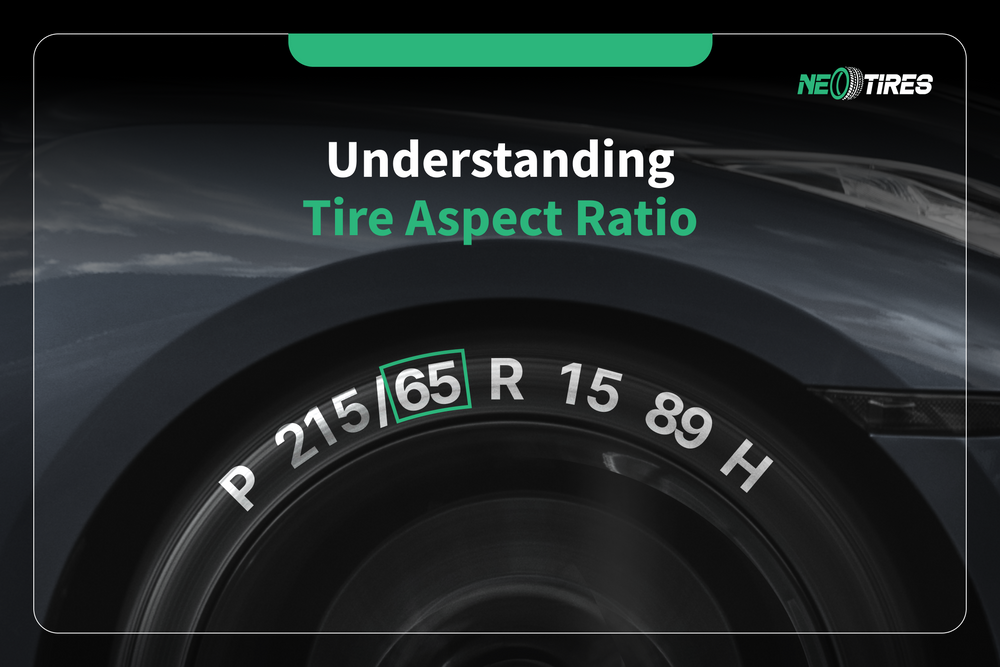
Tire aspect ratio is the second number in a tire size, and it gives the sidewall height as a percentage of the tire's width. In 225/50R17, the 50 means the sidewall is 50% of the 225 mm width, or 112.5 mm. Tire Aspect Ratio expresses the relationship between the height of a tire sidewall and its width. The ratio is expressed in percentage and influences a vehicle's handling and performance.
Below you'll find what tire aspect ratio means, where to find it on the tire sidewall, how to calculate it, a tire aspect ratio chart, what changes between 55, 60 and 65, and how to choose the right aspect ratio for your vehicle.
What Is Tire Aspect Ratio?
The tire aspect ratio (tyre aspect ratio in British English) is the relationship between a tire's sidewall height and its width. This proportion, expressed as a percentage (40, 50, 60), tells the vehicle owner how low-profile or high-profile a tire is. NHTSA defines it as the number that "gives the tire's ratio of height to width", and the U.S. Tire Manufacturers Association notes that aspect ratios typically range from 30 to 80.
Aspect Ratio Tire Size Meaning
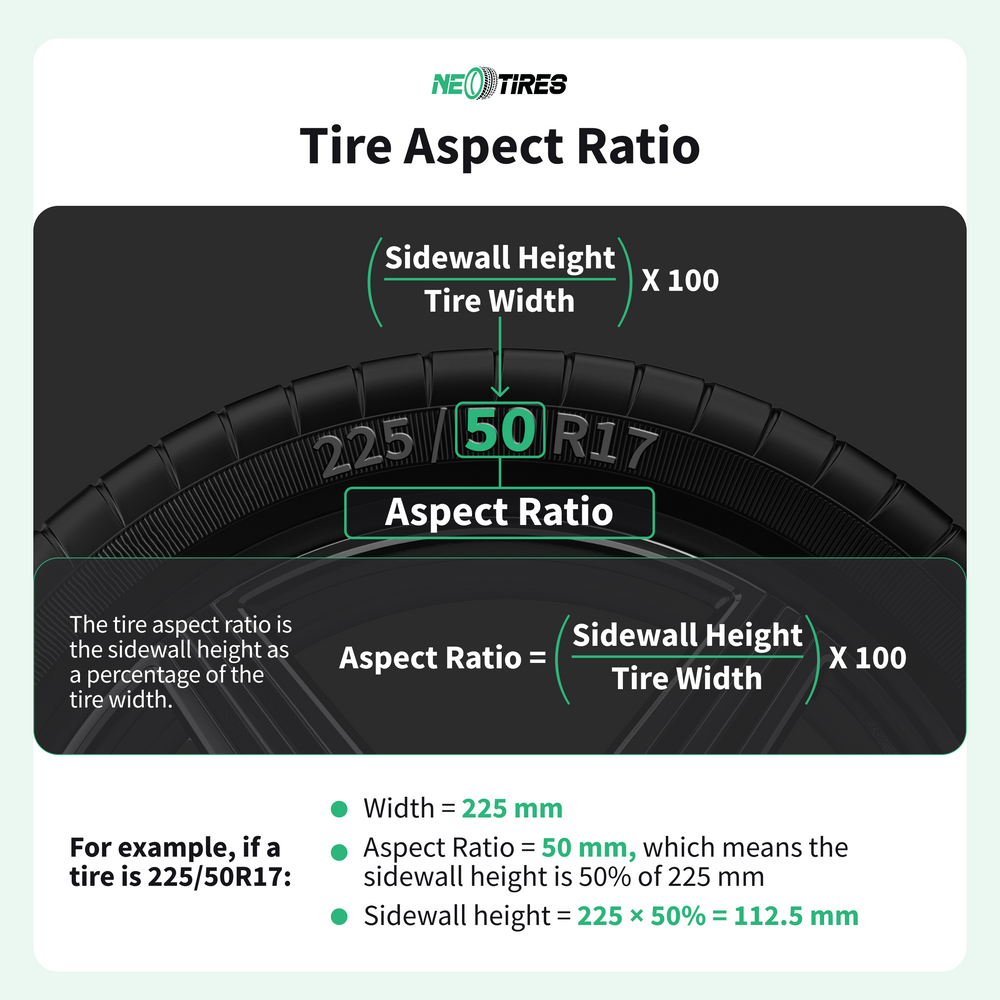
Aspect ratio is the second number in the tire size markings on the tire sidewall. Consider the 225/50R17 tire size example, in which the aspect ratio is 50. This number means that the sidewall height is 50% of the tire's width (225 mm, in our case). The sidewall height is 112.5 mm if your tire's width is 225 mm and the aspect ratio is 50.
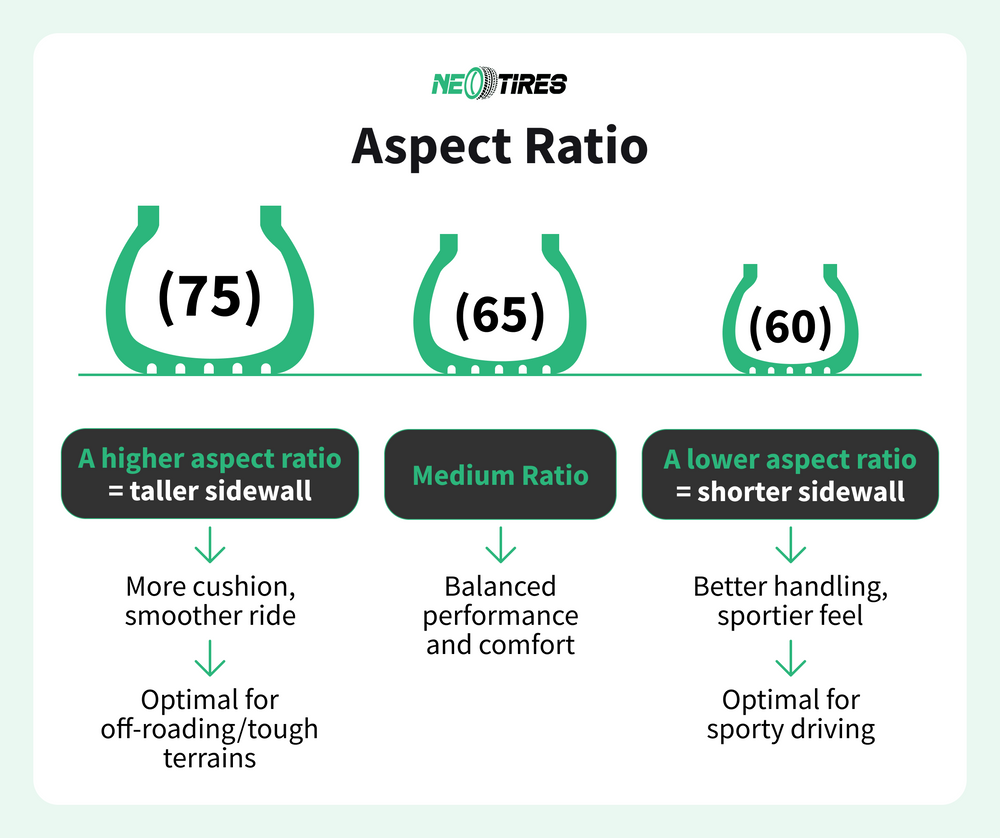
A higher aspect ratio means a taller sidewall and refers to a "high-profile" tire. A lower aspect ratio means a shorter, sportier sidewall and refers to a "low-profile" tire. The aspect ratio does not change the tire's width: a 225/55 and a 225/60 tire are both 225 mm wide, and the 60 has the taller sidewall.
Example of Tire Aspect Ratio Calculation
| Tire Size | Width (mm) | Aspect Ratio (%) | Sidewall Height (mm) |
|---|---|---|---|
| 225/50R17 | 225 mm | 50% | 112.5 mm |
| 245/40R18 | 245 mm | 40% | 98 mm |
| 275/60R20 | 275 mm | 60% | 165 mm |
How To Calculate Tire Aspect Ratio
Divide the sidewall height by the tire width and multiply by 100: aspect ratio = sidewall height ÷ width × 100. To get the sidewall height from a tire size, reverse it: sidewall height = width × aspect ratio ÷ 100.
- Sidewall height: 225 × 50 ÷ 100 = 112.5 mm (4.4 in) for a 225/50R17 tire.
- Overall tire diameter: wheel size × 25.4 + 2 × sidewall height. For 225/50R17: 17 × 25.4 + 2 × 112.5 = 656.8 mm, or 25.9 in.
- Inches: divide millimeters by 25.4.
Tire Aspect Ratio Chart
The chart shows the sidewall height in millimeters for common tire widths and aspect ratios. Find your width in the first column and your aspect ratio in the top row.
| Width | 40 | 45 | 50 | 55 | 60 | 65 | 70 |
|---|---|---|---|---|---|---|---|
| 205 mm | 82.0 | 92.3 | 102.5 | 112.8 | 123.0 | 133.3 | 143.5 |
| 215 mm | 86.0 | 96.8 | 107.5 | 118.3 | 129.0 | 139.8 | 150.5 |
| 225 mm | 90.0 | 101.3 | 112.5 | 123.8 | 135.0 | 146.3 | 157.5 |
| 235 mm | 94.0 | 105.8 | 117.5 | 129.3 | 141.0 | 152.8 | 164.5 |
| 245 mm | 98.0 | 110.3 | 122.5 | 134.8 | 147.0 | 159.3 | 171.5 |
| 255 mm | 102.0 | 114.8 | 127.5 | 140.3 | 153.0 | 165.8 | 178.5 |
| 265 mm | 106.0 | 119.3 | 132.5 | 145.8 | 159.0 | 172.3 | 185.5 |
| 275 mm | 110.0 | 123.8 | 137.5 | 151.3 | 165.0 | 178.8 | 192.5 |
Sidewall height (mm) = width × aspect ratio ÷ 100. Divide by 25.4 for inches.
Tire Aspect Ratio 60 vs 65, 55 vs 60 and 50 vs 55
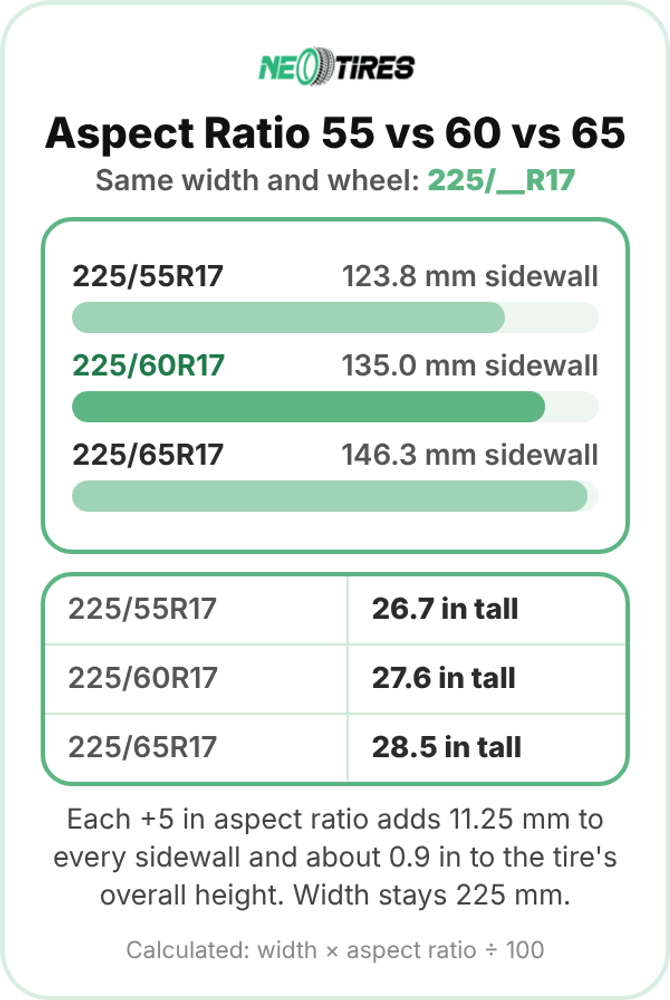
On the same width and wheel, a 65 tire has a taller sidewall and a larger overall diameter than a 60 tire. Each 5-point step adds 5% of the width to every sidewall: on a 225 mm tire, that is 11.25 mm per sidewall and about 0.9 in of overall height. A 225/60R17 tire has a 135 mm sidewall; a 225/65R17 has a 146.3 mm sidewall.
The higher number gives more cushion: Continental notes that tires with a higher aspect ratio offer more flexibility and absorb road imperfections more effectively, while a lower aspect ratio typically gives more precise steering. The width stays the same, so a 55 tire is not wider than a 60 tire in the same width.
| Sizes | Sidewall height | Overall diameter | Taller by |
|---|---|---|---|
| 225/60R17 vs 225/65R17 | 135.0 vs 146.3 mm | 27.6 vs 28.5 in | +3.2% |
| 225/55R17 vs 225/60R17 | 123.8 vs 135.0 mm | 26.7 vs 27.6 in | +3.3% |
| 225/50R17 vs 225/55R17 | 112.5 vs 123.8 mm | 25.9 vs 26.7 in | +3.4% |
| 205/50R16 vs 205/55R16 | 102.5 vs 112.8 mm | 24.1 vs 24.9 in | +3.4% |
| 245/40R18 vs 245/45R18 | 98.0 vs 110.3 mm | 25.7 vs 26.7 in | +3.8% |
Calculated from the tire sizes. A taller tire turns fewer times per mile, so the speedometer reads lower than your actual speed.
Can You Use Tires With a Different Aspect Ratio?
Only if the size is approved for your vehicle. NHTSA advises buying tires that are the same size as the vehicle's original tires or another size recommended by the vehicle manufacturer, listed on the tire information placard or in the owner's manual. The U.S. Tire Manufacturers Association adds:
- never choose a smaller size or a tire with less load-carrying capacity than the original size;
- do not mix tire sizes on four-wheel-drive and all-wheel-drive vehicles.
A different aspect ratio on the same wheel changes the tire's overall diameter, which Continental notes can change ride height, speedometer readings and braking response.
How Tire Aspect Ratio Affects Performance
Yes, tire aspect ratio matters: it impacts vehicle performance by influencing ride comfort, cornering stability, road noise, and handling. NHTSA notes that shorter sidewalls give improved steering response and better overall handling on dry pavement, and Continental notes that higher sidewalls absorb road imperfections more effectively.
- Low aspect ratio (40%-50%) – Better handling and enhanced steering response;
- Medium aspect ratio (55%-65%) – A balance of control and comfort;
- High aspect ratio (70% +) – Softer ride with better shock and noise absorption, great for off-roading and rough roads.
| Aspect Ratio | Effects on Performance |
|---|---|
| Low (40-50%) | Better handling, sportier look, firmer ride |
| Medium (55-65%) | Balanced performance and comfort |
| High (70% and above) | Smoother ride, better off-road capability |
How To Choose Tire Aspect Ratio
Start with the size on your vehicle's tire placard (driver's door jamb) or in the owner's manual: that is the aspect ratio your vehicle was built for. Within the sizes approved for your vehicle, consider your vehicle type, performance needs, and driving conditions.
Choose a lower aspect ratio (40-50%) for precise road feedback and high-performance driving on smooth roads, as on summer tires. A medium tire aspect ratio (55-65%) is optimal for control and comfort in daily commutes on passenger vehicles with all-season tires. Consider higher aspect ratios (70%+) for improved shock absorption when driving off-road and on rough terrain, particularly on off-roaders and light trucks with all-terrain tires.
Need Help Choosing the Right Tires?
At NeoTires, we help you find the right tires with the aspect ratio you need. Shop tires by size using the size on your placard, or contact our assistants at +1 302 276 8361 for customized suggestions. NeoTires dispatches orders the same day and delivers in 2–3 business days across the U.S., with free shipping on tires labeled Free Shipping. Get $20 off a set of 4 tires or $15 off 2 tires on your first order with a promo code. Drive safe and choose your tires wisely!
Sources