


The right PSI for your tires is the cold pressure on the tire placard on the driver's door jamb, also listed in the owner's manual. PSI stands for pounds per square inch. Typical cold pressures run from 28–36 PSI for cars to 35–45 PSI for SUVs and light pickups, while trailers, spare tires, and commercial trucks run higher. NHTSA counts nearly 11,000 tire-related crashes each year, so check your tire pressure at least once a month. Below you'll find normal tire pressure by vehicle type, whether 30 to 50 PSI is good, how low is too low, and a PSI-to-bar chart.
What PSI Should My Tires Be?
Your tires should be at the cold PSI on your vehicle's tire placard: the pressure the automaker set for its weight, load, and handling. As typical ranges, compact cars and sedans run 28–35 PSI, performance cars 32–36, SUVs and light pickups 35–45, light trailers 50–65, donut spares 60, and medium and heavy trucks 70–130+. The number on the tire sidewall is the maximum the tire can hold, not the pressure to drive on.
Normal Tire Pressure by Vehicle Type
Normal tire pressure depends on the vehicle type, its load, and how it's used. The table gives typical cold ranges, and the sections below break them down for cars, SUVs, pickups, heavy trucks, and trailers.
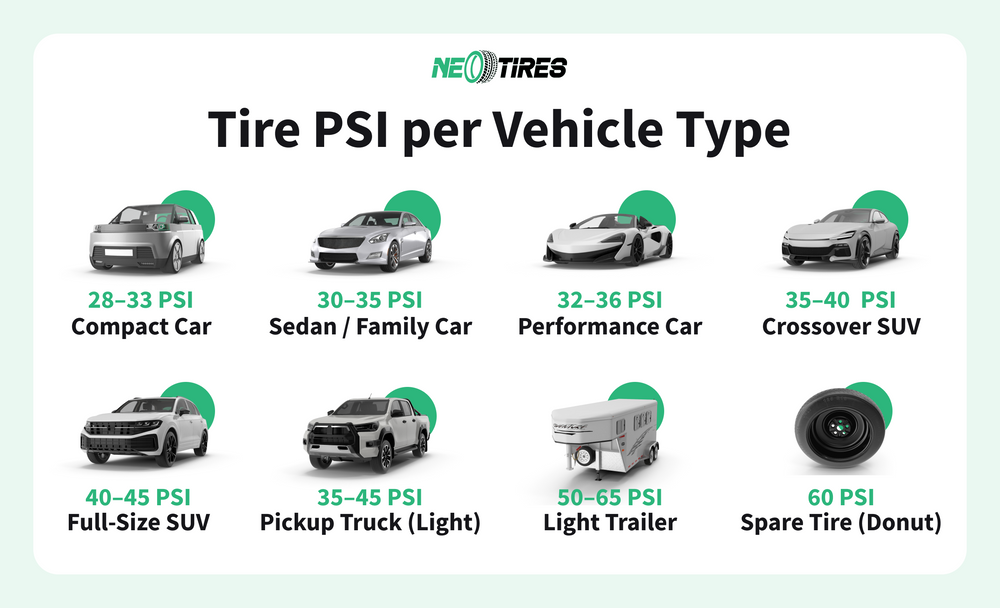
| Vehicle Type | Typical PSI (Cold) | Notes |
| Compact Car | 28–33 | City and light highway use |
| Sedan / Family Car | 30–35 | Balance of comfort and control |
| Performance Car | 32–36 | Supports high-speed stability |
| Crossover SUV | 35–40 | May need adjustment for passenger load |
| Full-Size SUV | 40–45 | May increase with towing |
| Pickup Truck (Light) | 35–45 | Higher when hauling heavy cargo |
| Light Trailer | 50–65 | Depends on the tire's load range |
| Spare Tire (Donut) | 60 | High pressure for its compact size |
Note: these are typical ranges only. The correct PSI for your vehicle is on the tire placard on the driver's door jamb or in the owner's manual.
Normal Tire Pressure for Sedans and Cars
Sedans and other passenger cars typically run 28 to 35 PSI in all four tires: compact cars 28–33, sedans 30–35, and performance cars 32–36. Cars with staggered sizes (wider rear tires) can list different front and rear pressures on the placard. If the steering feels loose and the car responds sluggishly, your tires may be underinflated and need a pressure check.
Normal Tire Pressure for SUVs
SUVs typically run 35 to 45 PSI: crossovers 35–40 and full-size SUVs 40–45. A heavy load or towing can call for a higher pressure, if your placard or owner's manual lists one for a loaded vehicle. Off-road, some drivers lower the pressure for grip on rough terrain; refill to the placard value before returning to the highway. In winter, pressure drops as temperatures fall, so check SUV tires more often and refill them to the placard value when cold.
Normal Tire Pressure for Pickup Trucks
Light pickup trucks typically run 35 to 45 PSI and full-size pickups 40 to 50 PSI. Many pickup placards and manuals list a higher pressure for hauling or towing than for empty driving: use the value given for your load, and never go above the tire's maximum pressure or its load capacity. Always inflate truck tires cold.
Ready to swap in a set built for your hauling and towing needs? Browse our Light Truck Tires for options rated for the loads you're carrying.
Semi-Trucks and Heavy-Duty Trucks
Medium and heavy trucks run much higher pressures, typically 70 to 130+ PSI, depending on the tire's load range, the load, and the use: box trucks 70–95 PSI, Class 8 semi-trucks 95–105 PSI, and dump and off-road trucks 100–130+ PSI.
| Truck Type | Typical PSI (Cold) | Typical Use |
| Light Pickup Truck | 35–45 PSI | Everyday use, occasional towing |
| Full-Size Pickup Truck | 40–50 PSI | Heavy or commercial tools |
| Box Truck (Class 3–5) | 70–95 PSI | Medium-duty delivery and logistics |
| Semi-Truck (Class 8) | 95–105 PSI | Long-haul freight |
| Dump Truck | 100–120 PSI | Construction and mining |
| Heavy-Duty Off-Road Truck | 120–130+ PSI | Quarry, logging, and off-highway use |
Trailers
Trailer tires typically run 50 to 65 PSI, and the tire's load range (B, C, D, E) sets its maximum cold pressure:
| Tire Load Range | Max PSI (Cold) |
| B | 35 |
| C | 50 |
| D | 65 |
| E | 80 |
The load each tire carries at that pressure depends on its size; see the load chart for your tire. For top brands, types, and ratings, read our Trailer Tires Guide.
Need trailer tires that can handle your load range? Right now: $15 off 2 tires and $20 off 4 tires.
- Hankook Vantra Trailer ST01: rated 5.0 out of 5 by NeoTires customers
- Hi Run LQ229 ST Bias: rated 5.0 out of 5 by NeoTires customers
- Or browse all Trailer Tires. Tires labeled Free Shipping ship free.
Is 30, 32, 35, 38, 40 or 45 PSI Good?
Each of these pressures is good only if it matches your vehicle's placard. Compared with the typical ranges above, this is where each one falls:
| PSI | Where It Fits |
| 30 PSI | Typical for compact cars and sedans; low for SUVs and pickups |
| 32 PSI | Typical for compact cars, sedans, and performance cars; low for SUVs and pickups |
| 35 PSI | Top of the sedan range; bottom of the SUV and light pickup range |
| 36 PSI | Top of the performance car range; typical for crossover SUVs |
| 38 PSI | Typical for crossover SUVs and light pickups; above the typical car range |
| 40 PSI | Typical for SUVs and pickups; high for sedans and compact cars |
| 45 PSI | Top of the full-size SUV and light pickup range; above the typical car range |
| 50 PSI | Typical for full-size pickups and load range C trailer tires; above the typical car and SUV range |
A pressure above your placard (but below the sidewall maximum) wears the center of the tread faster and reduces grip; see tire overinflation. A pressure below the placard makes the tire flex more, build heat, and wear on the shoulders.
What Does PSI Mean on a Tire?
PSI means pounds per square inch, the unit U.S. tire pressure is measured in. You'll see three PSI numbers, and only one is the pressure to drive on:
- Placard PSI (driver's door jamb, owner's manual): the recommended cold pressure for your vehicle. Inflate to this.
- Sidewall PSI (molded on the tire): the maximum pressure the tire can safely hold to carry its maximum load, not the daily recommendation.
- Gauge PSI: the pressure in the tire right now. Read it cold and compare it with the placard.
What Tire Pressure Is Too Low or Too High?
Tire pressure is too low when it is 25% or more below the placard: that's when the federal standard requires the TPMS warning light to come on, on vehicles up to 10,000 lb. On a 35 PSI placard, that's about 26 PSI. Tire pressure is too high when it goes above the maximum on the sidewall. Between those limits, keep the tires at the placard value, because both under- and overinflation change how the tire wears and grips.
Tire PSI in Cold and Hot Weather
Tire pressure drops in cold weather and rises in heat, by about 1 PSI for every 10°F. Check the pressure at least once a month and before long trips, in the morning before driving, and refill to the placard value.
Cold Weather
Tire pressure decreases by about 1 PSI for every 10°F drop, so a 30°F drop takes off about 3 PSI and can leave your tires underinflated. Check more often when temperatures fall, and refill to the placard value while the tires are cold.
Hot Weather
Air in your tires expands at high temperatures, which raises the reading and can lead to overinflation. Let air out only after the tire has cooled and still reads above the placard value. If you deflate based on a hot reading, the tire ends up underinflated once it cools.
PSI for Special Tires
Air Pressure in Spare Tires
A temporary donut spare needs 60 PSI, higher than most vehicles' regular tires, to carry the vehicle's weight on its smaller size. Check the spare's pressure at least every six months, and replace the spare tire with a regular tire as soon as possible, because it is not for long-term use.
Air Pressure in Run-Flat Tires
Run-flat tires use the same placard pressure as standard tires on your vehicle. Keep them at that pressure; their reinforced sidewalls are for getting you to a repair after a puncture, not for running low.
Tire Pressure: PSI to Bar and kPa Conversion
1 bar equals 14.5 PSI and 100 kPa. Multiply bar by 14.5 to get PSI, or divide PSI by 14.5 to get bar. Use the chart below if your vehicle manual or gauge shows one unit and your inflator another:
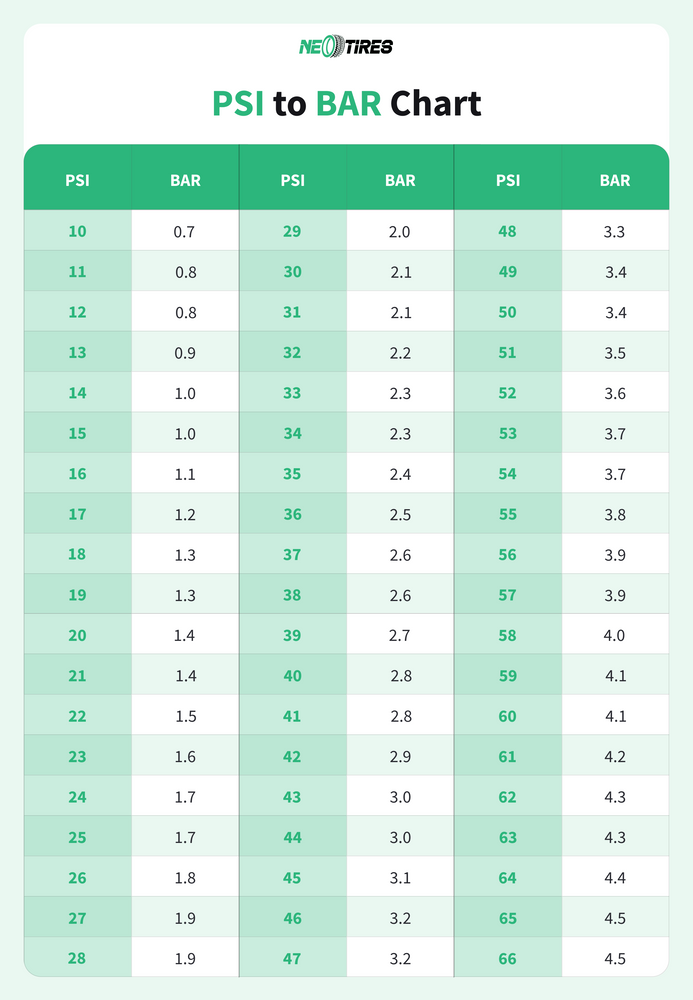
| Bar | PSI | kPa | Application Example |
| 1.0 | 14.5 | 100 | Off-road tires in specific conditions |
| 2.0 | 29.0 | 200 | Compact cars |
| 2.2 | 31.9 | 220 | Small sedans |
| 2.5 | 36.3 | 250 | Mid-size cars and SUVs |
| 3.0 | 43.5 | 300 | Full-size SUVs, light trucks |
| 4.0 | 58.0 | 400 | Trailer tires (Load Range C–D) |
| 6.0 | 87.0 | 600 | Commercial trucks |
| 8.0 | 116.0 | 800 | Heavy-duty industrial vehicles |
| 9.0 | 130.5 | 900 | Quarry and off-highway applications |
Where to Find Your Tire's Recommended PSI?
Your tire's recommended PSI is printed in three places:
- Driver's side door jamb: the tire placard, with the most accurate information for your vehicle
- Owner's manual: pressure and load recommendations
- Fuel door or glove box door: on some vehicles, instead of the door jamb
Don't use the PSI on the tire sidewall: it is the maximum, not the recommendation. If you're adjusting pressure or planning a replacement, check your tire size to make sure the specifications match your vehicle.
Keep Your Air Level in Check
Tire pressure changes with load, weather, and use, so check it at least once a month, cold, and keep it at the placard value. When it's time for new tires, NeoTires dispatches orders the same day and delivers in 2–3 business days across the U.S., and tires labeled Free Shipping ship free. Call us at +1 302 276 8361 to find the right fit, or browse our best deals if you know exactly what you need.
Drive safe and choose your tires wisely!
Sources