


Tire PSI stands for Pounds per Square Inch and is crucial to vehicle performance and safety. Every vehicle has a manufacturer-recommended tire pressure (PSI) that ensures optimal handling, even wear, and fuel efficiency. According to NHTSA, tires with lower PSI or underinflated tires contribute to over 11,000 tire-related crashes yearly on U.S. roads. In this section, we will examine the optimal tire pressure for each vehicle type and provide recommendations for adjustments based on specific driving conditions.
What PSI Should My Tires Be?
Most passenger vehicles fall between 28 and 36 PSI when cold. 30 PSI is generally typical for small car tires, while 36 PSI is appropriate for medium-sized vehicles. Proper pressure in larger vehicles like SUVs, crossovers, and light trucks falls between 35 and 45 psi, depending on their weight and size. Higher pressure levels, between 50 and 65 or more, apply to trailer tires. Donut spare tires need 60 PSI. The average tire pressure in semi-trucks, industrial, and heavy-duty trucks varies between 70 and 130+, based on ply rating, load, and use.
Recommended PSI by Vehicle Type
Optimal tire pressure is not a fixed value; it depends on the vehicle type, the load on it, and the conditions of use. It is essential to read the manufacturer's recommendations in the vehicle manual. Following them ensures optimal traction, tire life, and fuel efficiency.
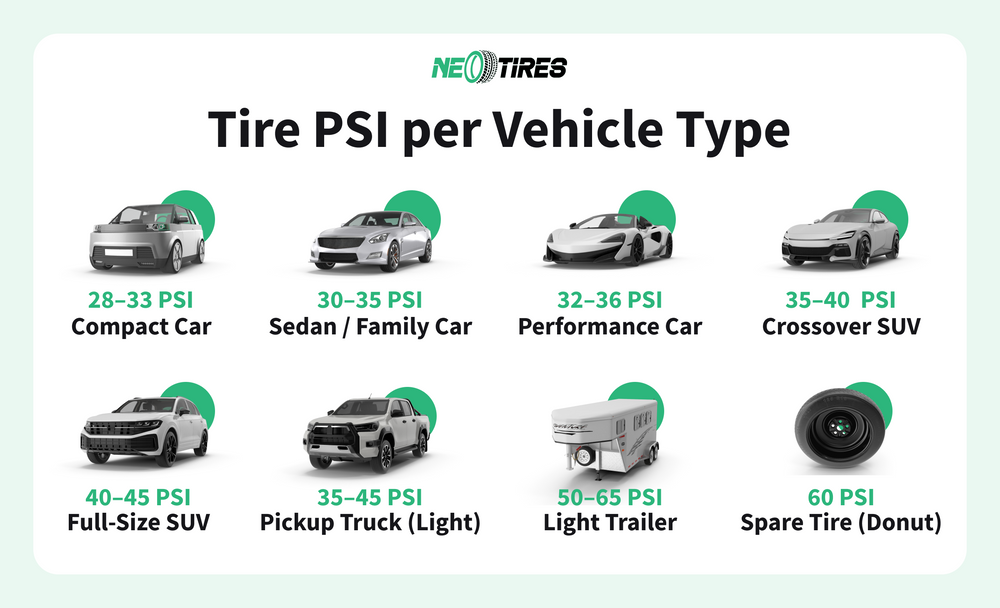
| Vehicle Type | Recommended PSI (Cold) | Notes |
| Compact Car | 28–33 | Optimal for city and light highway use |
| Sedan / Family Car | 30–35 | Balance of comfort and control |
| Performance Car | 32–36 | Supports high-speed stability |
| Crossover SUV | 35–40 | Might need adjustment depending on passenger load |
| Full-Size SUV | 40–45 | May increase with towing |
| Pickup Truck (Light) | 35–45 | Increase PSI when hauling heavy cargo |
| Light Trailer | 50–65 | PSI depends on Load Range |
| Spare Tire (Donut) | 60 | High pressure needed for compact size |
Note: These data are only general recommendations and should not replace the manufacturer's recommendations.
Passenger Cars
Optimal PSI for tires in standard cars typically requires 28 to 35 PSI in all four tires. Vehicles with wider rears (staggered tire sizes) might need different PSI in front and rear. If the steering feels loose and the vehicle's traction becomes sluggish, your tires may be underinflated and need pressure adjustment.
SUVs and CUVs
Crossovers and full-sized SUVs have pressures ranging from 35 to 45 PSI. Depending on the weight and load, the vehicle might require some extra air pumping, especially if it is involved in towing. On the other hand, off-road SUVs can have pressures lowered to 25-30 psi when some extra grip is needed on rough terrain. Make sure to add the pressure to the usual standard when you return to the highway.
Pickup Trucks
While 35-45 psi is a general range for light trucks and pickups, the tire pressure level depends on vehicle usage. 35-40 PSI applies to unloaded driving conditions. Increasing it to 40-45 is a good practice for towing and carrying loads. Always inflate truck tires cold and increase pressure without exceeding the tire's load capacity limit.
Trailers
Trailers usually need more pressure in their tires to support vehicle weight, generally between 50 and 65 PSI. The extra load, as well as the tire load-range (B, C ,D, E) determine the optimal pressure level as follows:
| Tire Load Range | Max Load Capacity | Recommended PSI |
| B | 1,430 lbs | 35 |
| C | 1,820 lbs | 50 |
| D | 2,540 lbs | 65 |
| E | 3,420 lbs | 80 (typical for trucks) |
For more info about trailer tires, including top brands, types, and ratings, check our dedicated article: Trailer Tires Guide.
Trucks: Semi-truck, Heavy-duty, Industrial
Considering the wide variety of trucks for different uses, tire PSI varies between 70 and 130+. Medium-duty delivery trucks generally fall between 70 and 95 PSI. Average tire pressure in semi-trucks ranges between 95 and 105 psi. Industrial and off-road heavy-duty applications' proper pressure ranges from 100 to 130+ psi.
Recommended PSI for Trucks: Light to Industrial
| Truck Type | Recommended PSI (Cold) | Typical Use |
| Light Pickup Truck | 35–45 PSI | Everyday use, occasional towing |
| Full-Size Pickup Truck | 40–50 PSI | Heavy or commercial tools |
| Box Truck (Class 3–5) | 70–95 PSI | Medium-duty delivery and logistics |
| Semi Truck (Class 8) | 95–105 PSI | Long-haul freight |
| Industrial Dump Truck | 100–120 PSI | Construction and mining use |
| Heavy-Duty Off-Road Truck | 120–130+ PSI | Quarry, logging, and serious off-highway use |
Tire PSI in Cold and Hot Weather
Air in tires contracts in cold weather and expands in heat. This is why you may notice changes in tire pressure, especially when temperatures fluctuate. Check your tire pressure weekly and adjust it to normal, especially in winter and summer when temperatures reach their peak. Also, be alert to your TPMS, which will alert you to pressure issues, especially in severe pressure drops.
Cold Weather
Air level in your tires decreases by about 1 PSI for every 10°F drop, which can lead to underinflation. To compensate for the loss, adding 2-3 PSI to the recommended level is a good practice, especially in cold climate areas.
Hot Weather
Air molecules in your tires expand at high temperatures, leading to overinflation. You can deflate your tires to the optimal level, but only after the tire has cooled and still shows overinflation. Otherwise, you risk overinflating your tires if you rely solely on hot readings.
PSI for Special Tires
Air Pressure in Spare Tires
When using the spare donut tire, its pressure level should be 60 PSI. This is a higher level than in most vehicles' tires. However, this PSI in a donut spare can safely support vehicle weight and compensate for its smaller size compared to other tires.
Replace the spare tire as soon as possible, as it is not for long-term use. We recommend checking and adjusting the spare tire pressure at least once every six months to keep it in shape for when you need it.
Air pressure in Run-Flat Tires
Drivers should maintain optimal air pressure in run-flat tires, just like in standard ones, to optimize their usability. Proper pressure in run-flats is around 36 to 38 PSI unless the manufacturer recommends otherwise.
Tire Pressure: PSI in Bar Conversion
While PSI is a U.S. standard for reading tire pressure, the Bar is equivalent for the European market. You need a conversion chart if your vehicle manual or tire gauge shows value in PSI, but your tire inflator is in Bars (or vice versa). The chart below helps you convert accurately psi in bar and bar in psi if needed:
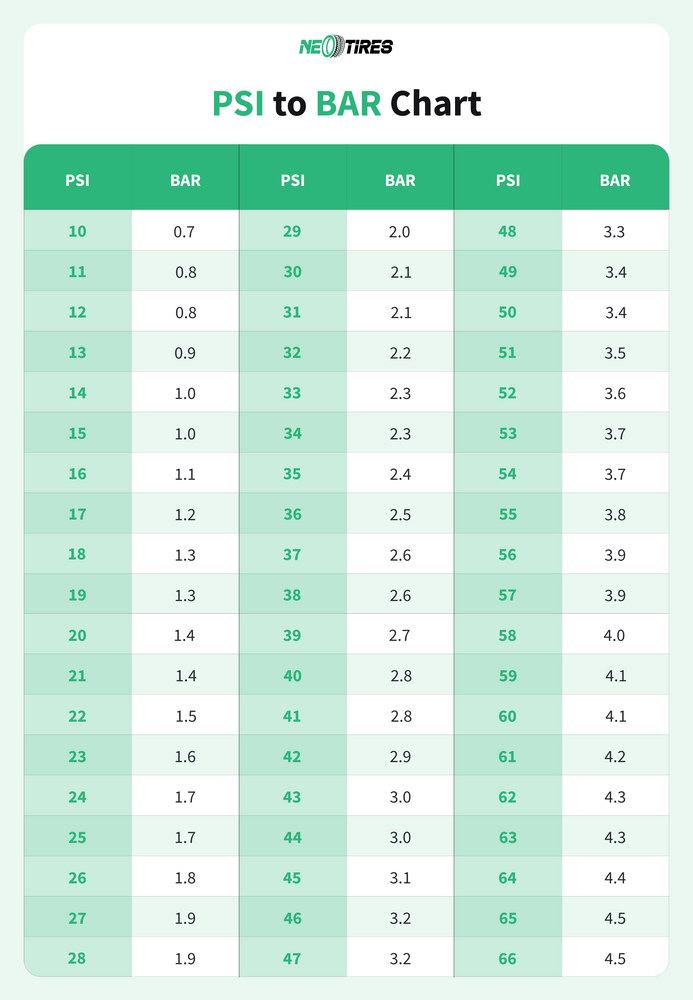
| Bar | PSI | Application Example |
| 1.0 | 14.5 | (off-road tires in specific conditions) |
| 2.0 | 29.0 | Compact cars |
| 2.2 | 31.9 | Small sedans |
| 2.5 | 36.3 | Mid-size and SUVs |
| 3.0 | 43.5 | Full-size SUVs, light trucks |
| 4.0 | 58.0 | Trailer tires (Load Range C–D) |
| 6.0 | 87.0 | Commercial trucks |
| 8.0 | 116.0 | Heavy-duty industrial vehicles |
| 9.0 | 131.0 | Quarry, military, and off-highway applications |
Where to Find Your Tire's Recommended PSI?
There are several options to find the optimal pressure that the manufacturer recommends for your tires. These include:
- Owner's manual: with both pressure and load recommendations
- Driver's side door jamb: with the most accurate info for the specifics of your vehicle
- Sticker on the fuel door or glove box door: alternatives for the sticker on the driver's side door jamb.
PSI on Tire Sidewall
PSI on the sidewall refers to the maximum pressure levels, NOT the daily recommendation! The maximum pressure (on the sidewall) is the highest pressure the tire can safely hold to carry its maximum load capacity. The recommended pressure is the optimal air level for your vehicle under usual driving conditions. You should stick to the recommended PSI for safety purposes.
Keep Your Air Level in Check
Tire pressure is not a fixed variable; it's dynamic and fluctuates depending on load, weather, vehicle weight, and even the terrain you're rolling on. The wisest thing to do is to stick to your manufacturer's guidelines, which ensures optimal performance and safe driving.
Looking for new tires that match your car's PSI requirements? Talk to us to find the right fit or check our catalog for the best deals if you know exactly what you need. We're here to guide and assist in any tire-related matter.
Why Trust Us?
NeoTires is here to ensure that your driving gets smarter and safer with the right tires. With a background of over five years, we help motorists fit their driving needs and budget with highly ranked products in the tire industry. We offer professional advice designed for real-world driving scenarios and practical tips backed by years of experience.
Still have questions about tires or tire PSI? Contact us anytime—we're happy to assist. Drive safe and choose your tires wisely!