


Every wheel swap starts with the same question: Will it physically mount to the hub? The bolt pattern is what answers that. Get it wrong and nothing else about the wheel matters - diameter, offset, finish - none of it is relevant if the lug holes don't line up correctly with the vehicle's mounting surface.
This guide covers what bolt patterns are, how they're expressed, how to measure them, and why a pattern that looks close enough almost never is. For a full breakdown of how bolt pattern fits within the broader wheel fitment decision - alongside offset, center bore, load rating, and lug seat type - see our complete Aftermarket Wheel Fitment Guide.
What Is a Wheel Bolt Pattern?
A wheel bolt pattern - sometimes called a lug pattern - is the arrangement of the lug holes in the center of a wheel, expressed as two numbers: the count of bolt holes and the diameter of the imaginary circle they form around the hub center.
A 5x114.3 bolt pattern, for example, means five lug holes positioned on a circle with a 114.3 mm diameter. Both numbers must match the vehicle's hub exactly - not approximately, exactly.
The distinction matters more than it might seem. A Ford Mustang uses a 5x114.3 bolt pattern. A Jeep Wrangler uses 5x127. Both are five-lug wheels. Both look similar on the shelf. But their bolt circles are different enough that mounting one vehicle's wheel on the other's hub without an adapter is not possible - and adapters carry their own set of fitment and safety considerations that are worth understanding before going that route (covered below).
Why a Close Bolt Pattern Is Not a Safe Bolt Pattern
5x112 and 5x114.3 are not interchangeable. That 2.3 mm difference in bolt circle diameter means the lug nuts cannot seat flush in the wheel's lug holes when mounted on the wrong hub. Instead of the full tapered or radius contact surface carrying the clamping load evenly across all five lugs, the hardware contacts the wheel at an angle - creating uneven stress, inconsistent clamping force, and a real risk of loosening under load.
The failure mode is not always immediate. A wheel mounted on a mismatched bolt pattern may feel secure during installation and even behave normally at low speed. The problem typically shows up as vibration, lug loosening, or - in worst cases - fastener damage that only becomes visible once something goes wrong. This is why bolt pattern verification is a must in any wheel fitment check, not an afterthought.
Types of Wheel Bolt Patterns
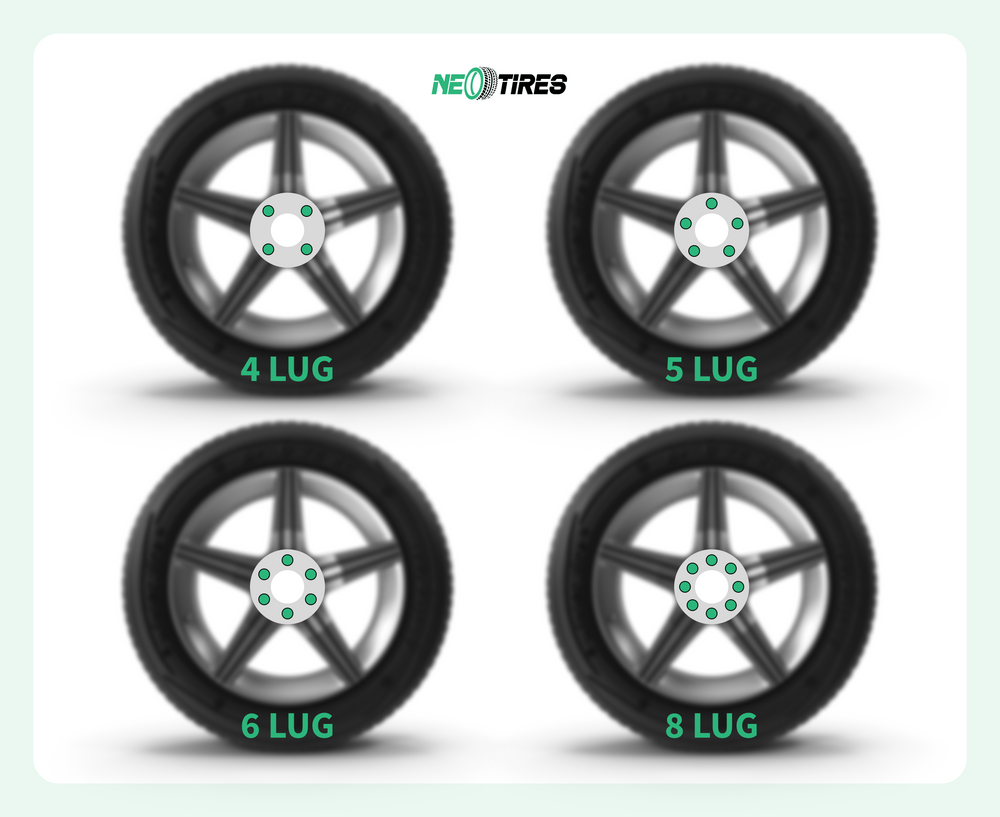
There are three main types of wheel bolt patterns: even bolt patterns, odd bolt patterns, and specialized bolt patterns. Even bolt options can be 4-bolt and 6-bolt patterns. Odd bolt wheel options include 5-bolt patterns with several diameter variations (5 x 4.5, 5 x 127, 5 x 120, 5 x 115...). Specialized bolt patterns refer to unique configurations such as 8-bolt patterns (heavy-duty trucks like the Ford F-250 or Ram 2500) and multi-bolt patterns (e.g., 5 x 114.3 and 5 x 120 combined).
What Are the 4 Bolt Patterns?
A 4-lug pattern is the arrangement of 4 bolts/lugs on a wheel in a circular/cross pattern. The variable number following the "4" expresses the circle's diameter formed by these bolts (e.g., 4 x 4.25, 4 x 4.5, etc). The diameter is usually measured in inches and converted to millimeters if needed, as follows:
| 4-Bolt Pattern in Inches | 4-Bolt Pattern in mm |
| 4 x 4.25" | 4 x 108mm |
| 4 x 4.5" | 4 x 114.3mm |
| 4 x 3.86" | 4 x 98mm |
| 4 x 3.94" | 4 x 100mm |
| 4 x 4.33" | 4 x 110mm |
| 5 x 4.25" | 5 x 108mm |
| 5 x 4.5" | 5 x 114.3mm |
| 5 x 4.75" | 5 x 120.7mm |
4-Bolt Pattern Conversion Chart (inches to mm)
Four-lug wheels are most common on smaller passenger cars and older compact platforms.
What Are the 5 Bolt Patterns?
A 5-lug pattern refers to the odd arrangement of 5 bolts in the center of a wheel in a circular pattern. The number following "5" shows the diameter of the circle these 5 bolts form (e.g., 5 x 5, 5 x 5.5, 5 x 6.5, etc). The diameter is mostly expressed in inches and can be converted into millimeters as follows:
| 5-Bolt Pattern in Inches | 5-Bolt Pattern in mm |
| 5 x 5" | 5 x 127mm |
| 5 x 5.5" | 5 x 139.7mm |
| 5 x 6.5" | 5 x 165.1mm |
| 5 x 3.86" | 5 x 98mm |
| 5 x 3.94" | 5 x 100mm |
| 5 x 4.33" | 5 x 110mm |
| 5 x 4.41" | 5 x 112mm |
| 5 x 4.52" | 5 x 115mm |
| 5 x 4.72" | 5 x 120mm |
| 5 x 5.12" | 5 x 130mm |
| 5 x 5.3" | 5 x 135mm |
| 5 x 5.91" | 5 x 150mm |
| 5 x 6.1" | 5 x 155mm |
| 5 x 8.07" | 5 x 205mm |
5-Bolt Pattern Conversion Chart (inches to mm)
Five-lug wheels are the most common configuration in the U.S. aftermarket, covering the majority of passenger cars, crossovers, SUVs, and light trucks.
What Are the 6-Bolt Patterns?
A 6-lug pattern is the arrangement of the 6 bolts in the center of the wheel. The "6" is followed by a second number showing the diameter of the circle these lugs form. For example, the 6 x 4.5" bolt pattern represents 6 lugs forming an imaginary circle with a diameter of 4.5 inches. The 6-bolt pattern inches can be expressed in millimeters as follows:
| 6-Bolt Pattern in Inches | 6-Bolt Pattern in mm |
| 6 x 4.5" | 6 x 114.3mm |
| 6 x 5" | 6 x 127mm |
| 6 x 5.5" | 6 x 139.7mm |
| 6 x 4.52" | 6 x 115mm |
| 6 x 5.2" | 6 x 132mm |
| 6 x 5.3" | 6 x 135mm |
6-Bolt Pattern Conversion Chart (inches to mm)
Six-lug wheels are standard on mid-size and full-size trucks, larger SUVs, and body-on-frame platforms where the hub needs to distribute load across more fastening points.
What Are the 8-Bolt Patterns?
An 8-bolt wheel pattern means the center of a wheel has 8 holes for 8 lugs. The number following the "8" shows the diameter of the circle that these eight lugs/bolts form. The diameter is expressed in inches or millimeters as follows:
| 8-Bolt Pattern in Inches | 8-Bolt Pattern in mm |
| 8 x 6.5" | 8 x 165.1mm |
| 8 x 6.5" | 8 x 165mm |
| 8 x 6.69" | 8 x 170mm |
| 8 x 787" | 8 x 200mm |
8-Bolt Pattern Conversion Chart (inches to mm)
Eight-lug wheels appear on heavy-duty trucks and commercial platforms where axle loads are significantly higher.
Common Bolt Patterns by Vehicle Application
Bolt Pattern | Common Vehicles |
5x114.3 | Ford Mustang, Toyota RAV4, Nissan, Jeep Cherokee, Honda |
5x127 | Jeep Wrangler, Dodge trucks |
5x120 | BMW, Chevrolet Camaro |
5x115 | Dodge Charger, Chrysler 300, Cadillac |
5x112 | Mercedes-Benz, Audi, Volkswagen |
6x139.7 | Toyota Tacoma, Chevrolet Silverado 1500, GMC Sierra |
8x165.1 | Ford F-250, Ram 2500, and heavy-duty trucks |
The bolt circle diameter on these platforms reflects the hub geometry of the vehicle - larger hubs on heavier platforms use wider bolt circles to provide the structural spread needed for higher load. Bolt circle diameter is a consequence of platform design, not an independent performance variable.
How to Measure a Wheel Bolt Pattern
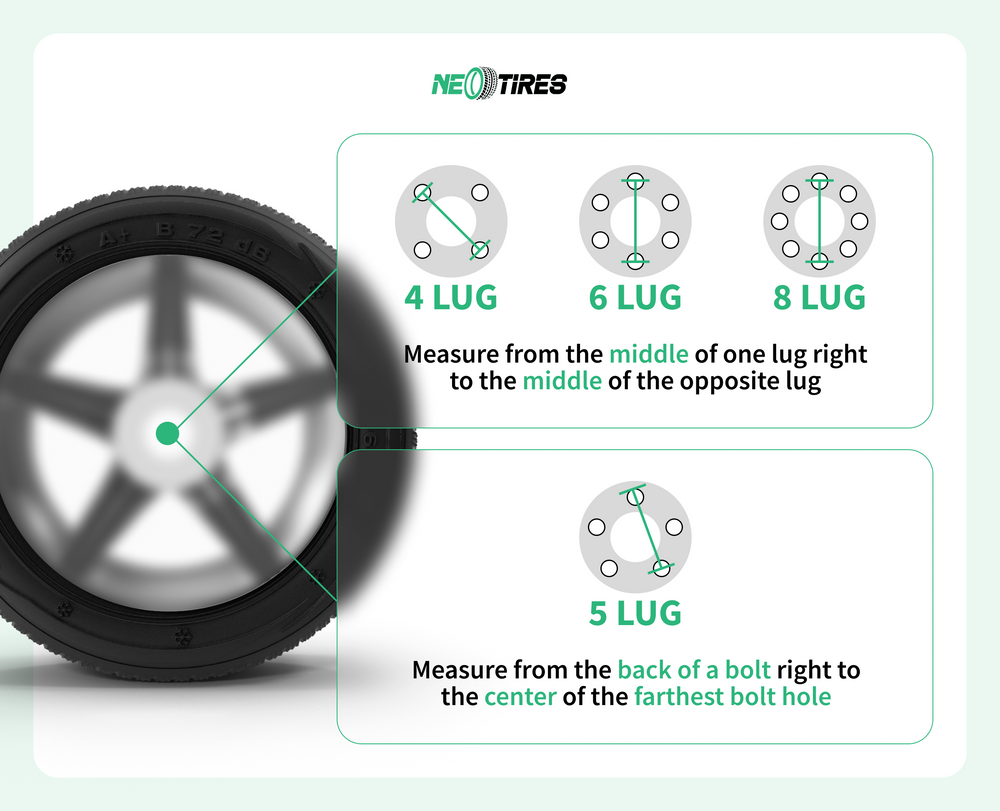
Use a caliper or ruler to measure a wheel bolt pattern by applying it from the center of one lug hole to the center of the opposite lug hole for wheels with an even number of bolts. That is how you find out the measurement of the bolt circle diameter. Consider the distance from the center of one lug hole to the outer edge of the farthest lug hole, in case of an odd number of wheel bolts. Use the bolt pattern conversion chart example below to find out the diameter of the bolt circle:
| Number of Bolts | Measurement from Center of One Lug to Outer Edge of Opposite Lug | Bolt Circle Diameter (Approx.) |
| 5 | 2.5 inches | 4.25 inches (108 mm) |
| 5 | 2.75 inches | 4.5 inches (114.3 mm) |
| 5 | 3 inches | 5 inches (127 mm) |
| 5 | 3.25 inches | 5.5 inches (139.7 mm) |
Bolt pattern conversion chart to help measure the exact diameter for wheels with odd numbers of bolts
Tools To Measure Wheel Bolt Pattern
Wheel Bolt Pattern Chart
Consider the bolt pattern chart below to simplify your search for compatible wheels. For example, a driver replacing wheels on a Jeep Cherokee (Jeep vehicle category) can use the chart to identify the 5 x 127 bolt pattern as a compatible fit:
| Number of Bolts | Diameter (inches) | Common Vehicles |
| 4 | 4 | Small cars |
| 5 | 4.5 | SUVs, sedans |
| 5 | 5 | Trucks, Jeeps |
| 6 | 5.5 | Larger trucks |
How to Find Bolt Pattern on Rims
Many aftermarket wheels have the bolt pattern stamped or engraved on the back of the wheel barrel. Look for a marking like 5x114.3 or 5x4.5 on the inner lip or rear face of the wheel. Not all wheels include this - if the marking is absent, measure directly using the method above or check the manufacturer's spec sheet for the wheel model.
For the vehicle side, the hub bolt pattern is listed in the owner's manual, on a sticker inside the driver's door jamb, or through the manufacturer's fitment database. When in doubt, measure the hub directly rather than relying on memory or third-party databases alone.
Bolt Pattern and Lug Seat Type: Two Separate Checks
Confirming the bolt pattern is necessary but not sufficient for safe wheel installation. The lug seat type - the shape of the contact area between the lug nut and the wheel's mounting hole - must also match.
The two most common types are:
Conical (tapered) seat - the lug nut has an angled cone that seats into a matching tapered hole in the wheel. Standard on most U.S. and Japanese vehicles.
Ball (radius) seat - the lug nut has a curved, rounded contact surface that mates with a spherical recess in the wheel. Common on European vehicles, including BMW, Mercedes-Benz, and Volkswagen Group platforms.
A wheel with the right bolt pattern but the wrong lug seat type will not fasten correctly. The nut contacts the wheel at the wrong angle, creating point loading instead of full surface contact. The result is uneven clamping force across the lugs - a condition that can lead to loosening under load even when the torque spec was followed correctly at installation.
Always confirm the lug seat type required by the aftermarket wheel before selecting hardware.
A Note on Bolt Pattern Adapters
- Adapters that allow a wheel with one bolt pattern to mount on a hub with a different pattern exist and are widely available. They are not a straightforward solution. A quality adapter from a reputable manufacturer, installed correctly and torqued to spec, can function safely in specific applications - but they add a mechanical interface between the wheel and the hub that introduces additional variables:
- adapter thickness changes the wheel's effective offset
- the adapter itself must be rated for the vehicle's load
- the hardware at both interfaces (hub-to-adapter and adapter-to-wheel) must be maintained and checked regularly.
If you're considering an adapter to make a non-matching bolt pattern work, consult a qualified installer and confirm the adapter's load rating against your vehicle's actual per-wheel demand. Using an adapter to force a fitment that doesn't otherwise exist is a different scenario from using one for a specific performance or fitment purpose - the distinction matters.
Final Checklist Before Buying Wheels Based on Bolt Pattern
Before ordering, confirm:
- Bolt pattern lug count matches the hub exactly
- Bolt circle diameter matches the hub exactly - not approximately
- Lug seat type (conical vs. ball) matches the required hardware
- If using an adapter: adapter load rating, thickness impact on offset, and hardware maintenance plan are all addressed
Bolt pattern is the first fitment check - but it is not the only one. Center bore, offset, width, load rating, and TPMS compatibility all require separate verification before a wheel is confirmed safe fit. The full sequence is covered in our Aftermarket Wheel Fitment Guide.
NeoTires Makes Finding the Right Wheels Easy
Understanding the wheel bolt pattern is crucial for proper tire fitting. The right fit makes all the difference, whether you replace old tires or upgrade for better performance. Need wheels that match your vehicle perfectly? Browse our catalog or simply chat with our experts for guided assistance! Drive safe and choose your wheels and tires wisely!