


Studded tires can reduce stopping distances on ice by up to 15%. However, studded tires are not legal everywhere in the U.S., and they may not always be the best choice. This guide explains how studded tires work, the laws in each state, compares studded tires with regular winter tires, and answers whether studded tires are worth it for your winter driving conditions.
Quick Summary: Studded Tires in 2025
Best for: Winter roads like in Vermont, Kentucky, or Wyoming, and regions with persistent ice below 20°F (during legal seasons).
Key Benefits of studded tires:
- ≃15% shorter stopping distances on glare ice vs studless winter tires
- Superior traction on frozen roads and black ice
- Recommended for mountainous/hilly icy terrain
Important Limitations:
- Legal only during winter months in most states- typically Nov-Apr (verify your state's dates below)
- Damage asphalt roads; that's why they're seasonally restricted
- Louder and less effective on bare/wet pavement than studless tires
Key Point: Studded tires are worth it for extreme ice conditions during legal winter periods; modern studless winter tires perform better in mild and mixed weather. Or, for occasional winter driving or when studs are prohibited, Tire Socks offer a portable, practical alternative.
Table Of Contents
What Are Studded Tires?
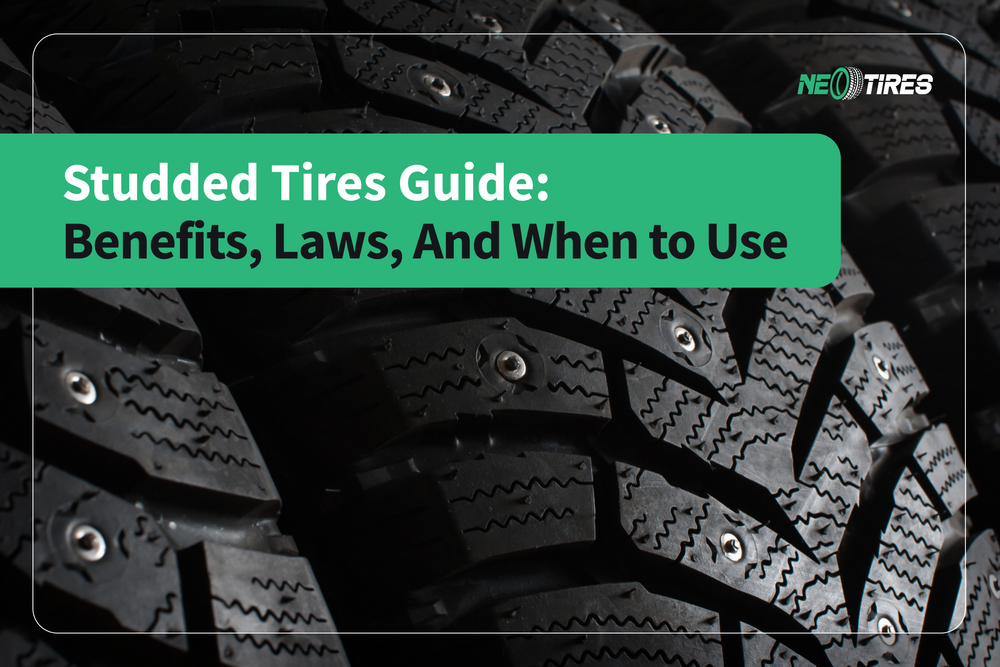
Studded tires are winter tires equipped with small metal pins, called tire studs, that dig into icy road surfaces for added traction.
These studs are typically made from tungsten-carbide, a material nearly three times harder than steel, and are pressed into the tire tread during manufacturing or added later.
When driving on frozen pavement, each stud briefly digs into the ice. It breaks through the thin layer of surface water created by tire friction. This grip helps prevent wheel spin and lowers braking distances on glare ice. In this situation, regular winter tires often lose traction completely.
How Do Studded Tires Work?
The metal studs penetrate the microscopically thin water film that forms on icy surfaces from pressure and heat, anchoring into the solid ice to provide mechanical traction. Tire rubber alone cannot maintain grip in these conditions, as it depends on the friction that disappears on the slippery film.
Laboratory tests show that studded tires can shorten stopping distances on glare ice compared with studless tires. For example, according to a WSDOT document study, stopping distances for studded tires were ~15% shorter than for a good studless winter tire [1].
However, the benefit of studded tires is only under a narrow set of conditions- smooth ice near freezing; their traction advantage often disappears (or can reverse) on snow, wet or bare pavement, or as the studs wear.
Where and When Are Studded Tires Most Effective?
Studded tires perform best in regions with prolonged sub-freezing winters, generally areas that remain below 20 °F (-6 °C) for weeks at a time. Studs in tires are particularly valuable where glare ice, freezing rain, and hilly terrain combine to create constant slip risk.
Examples of U.S. regions where studded tires are widely used include:
- Colorado Rockies (Aspen, Vail, Breckenridge)
- Range foothills (Boulder, Estes Park)
- Eastern Kentucky Highlands (Pikeville, Hazard)
- Northern Kentucky (Covington, Florence)
- White Mountains, New Hampshire (Mount Washington, Lincoln)
- Great North Woods, New Hampshire (Colebrook, Pittsburg)
- North Carolina High Country (Boone, Blowing Rock, Banner Elk)
- Western North Carolina mountains (Asheville, Hendersonville)
- 9. Upstate South Carolina (Greenville, Travelers Rest)
Studded vs. Studless Winter Tires: Performance Comparison
The main difference between studded and studless winter tires is how the two tire types create traction in extreme cold. Studded tires use metal pins that dig into ice, which gives them an advantage on frozen and slippery surfaces. In contrast, studless winter tires use specialized rubber compounds and detailed siping to grip snow and cold pavement better. The special rubber compounds in winter studless tires provide improved everyday handling, shorter stopping distances on wet and dry roads, and a quieter ride. The table below outlines how each type performs in key conditions:
Feature | Studded Tires | Studless Winter Tires |
Traction on Ice | Excellent - carbide studs penetrate ice surface | Good - uses specialized rubber & sipes |
Traction on Snow | Strong, but studs add limited benefit | Excellent - optimized tread design |
Performance on Wet/Dry Pavement | Reduced grip, increased braking distance | Better control and shorter stops |
Noise Level | Generally higher | Quieter and comfortable |
Road Surface Impact | Can cause asphalt rutting over time* | Minimal wear |
Best For | Consistently icy, frozen roads | Mixed to severe snow conditions |
*According to WSDOT’s controlled studies, rut depth from studded tire traffic can reach several millimeters per season, equivalent to roughly 0.2 inches of surface wear under heavy use — one reason many states restrict them [2].
Studded Tires: Laws Per U.S State
Six U.S states allow the use of studded tires, ten states prohibit completely, while the rest regulate tire studs use based on specific conditions. Studded tire legality is managed at the state level under DOT regulations. Here is the breakdown per state:
U.S States With No Restrictions On Studded Tire Use
State | General Overview | Seasonal Restrictions | Exceptions |
Colorado | No restrictions except to “not damage the road surface” | None | None. |
Kentucky | No restrictions except to “not damage the road surface” | None | Specifications for lugs used on tractors and other specific vehicles. |
Wyoming | No restrictions except to “not damage the road surface” | None | Certain husbandry equipment, tractors, and others by permit |
New Hampshire | No restrictions except to “not damage the road surface” | None | Not Specified |
New Mexico | No restrictions except to “not damage the road surface” | None | Not Specified |
Vermont | No restrictions except to “not damage the road surface” | None | Not Specified |
U.S. States Prohibiting Studded Tire Use
State | General Overview | Seasonal Restrictions | Exceptions |
Alabama | Studs prohibited | Not permitted at any time. | Farm machinery with studs that will not injure the highway or emergency |
Florida | Studs prohibited | Not permitted at any time. | Studs that do not harm roads; some farm equipment and DOT construction equipment. |
Hawaii | Studs prohibited | Not permitted at any time. | Certain roads in Mauna Kea Science Reserve and some tractors. |
Illinois | Studs prohibited | Not permitted at any time. | Not specifiied |
Louisiana | Studs prohibited | Not permitted at any time. | Rubber studs are accepted |
Minnesota | Studs prohibited | Not permitted at any time. | Rural mail carriers, farm or husbandry vehicles, tractors, permits issued by local/state authorities, certain nonresidents. |
Mississippi | Studs prohibited. | Not permitted at any time. | Certain farm and tractor equipment. |
Texas | Studs prohibited | Not permitted at any time. | Rubber studs "not damaging the road surface" are allowed |
Wisconsin | Studs prohibited | Not permitted at any time | Emergency vehicles, school buses, mail delivery vehicles, and automobiles with out-of-state registration |
Michigan | Not permitted | Not permitted at any time | Farm machinery, law enforcement, rural postal carriers, emergency vehicles |
U.S States Conditionally Allowing Studded Tires
State | General Overview | Conditions of use | Exceptions |
Alaska | Permitted to use “pneumatic tires having studs designed to improve traction without substantially injuring the surface of the highway.” | Studs permitted Sep 15 - May 1; South of 60° - Sep 30 - Apr 15. | None specified |
Arizona | Permitted to use pneumatic tires containing tungsten carbide or similar studs; metal contact ≤ 3% of total tire area. | Studs permitted Oct 1 - May 3. | None specified |
Arkansas | Studs cannot protrude more than 1/16 inch from the surface. | Studs permitted November - April. | |
California | Permitted with tungsten carbide or similar studs; metal contact ≤ 3% of total tire area. | Studs permitted Nov 1 - Apr 30 (may be extended by state DOT Commissioner). | Construction vehicles, traction engines, tractors, emergency vehicles. |
Connecticut | Seasonal restrictions only. | Studs allowed Nov 15 - Apr 30. | Emergency vehicles. |
Washington | Studs permitted but must be metal, tipped with tungsten carbide, and inserted only in a new tire or a newly-recapped tire which has molded pin-holes. Must have ≥70 studs evenly spaced; minimum 56 metal studs at all times. Prohibited on vehicles >10,000 lbs. | Nov. 1 - Mar. 31 | School buses, fire department equipment |
West Virginia | Studs permitted; not allowed on vehicles with air pressure >40 psi. | Nov. 1 - Apr. 15 | Farm machinery, school buses, certain tractors (with permit) |
Maine | Seasonal restrictions only. | Studs permitted Oct. 1 through Apr. 30. | Front-wheel drive vehicles with studded front tires must have studs on rear tires as well. |
Maryland | Studs prohibited in most counties, except Allegany, Carroll, Frederick, Garrett, and Washington counties during the prescribed period. Max studs ≤1¼% (0.0125) of tread area and ≤150 studs per tire. | Studs permitted Nov. 1 - Mar. 31 in Allegany, Carroll, Frederick, Garrett, and Washington countries. | None |
Massachusetts | Seasonal restrictions only. | Studs permitted Nov. 2 – Apr. 30. | As approved by the Registrar of Motor Vehicles. |
Missouri | Seasonal restrictions only. | Studs permitted Nov. 1 Mar. 31. | None |
Regulations summarized from official state transportation and highway codes (e.g., “Wyoming Statutes §31-5-956,” “29-A MRSA §1769,” “Minnesota Statutes §169.72”).
Do Studded Tires Damage Roads?
Yes. Repeated contact between metal studs and asphalt leads to rutting, pavement polishing, and increased spray in wet conditions.
To mitigate damage, some manufacturers now use lightweight aluminum studs or rubber-cushioned bases that flex on impact, reducing the cutting force. These designs, however, remain uncommon and more expensive in the U.S. market.
How Long Do Studded Tires Last?
Studded tires can last about five to six winter seasons if used mostly on ice and packed snow, where friction is low. Ice and packed snow conditions allow the tread and the metal studs to wear down more slowly.
Driving often on bare or wet pavement speeds up stud wear and can greatly reduce studded tire lifespan to 2-3 seasons.
Studded tires do not have a specific lifespan because their wear rate relies on driving conditions and road surfaces.
Are Studded Tires Worth It?
Yes, studded tires are worth it but only if your roads stay frozen for most of the winter.
Drivers in northern or mountainous states with persistent ice will benefit from the extra traction and shorter stopping distances that studs provide.
For most urban or mixed-climate drivers, however, modern studless winter tires achieve nearly the same ice performance with fewer downsides: less noise, no pavement damage, and legal year-round use. Our How To Buy Tires By Climate article helps you make the right choice in buying the right tires based on your local conditions.
How Can NeoTires Help?
Choosing the right winter tire solution depends on your driving conditions, local laws, and vehicle needs. At NeoTires, we know that managing studded tire laws, comparing studless options, and finding the right fit for your winter commute can be tough.
Our tire experts can help you:
- Decide if studded tires are right for you: We'll look at your usual driving routes, local weather patterns, and state regulations to suggest the best winter traction solution.
- Compare studded and studless options: Get personalized advice based on real-world performance data for your specific conditions.
- Choose studdable /studless or all-season tire models: Access top brands with factory-made stud holes and proper support for safe installation.
-Ship fast to your home or local installer withi 2-3 business days.
Whether you're driving through Colorado mountain passes, navigating Kentucky's icy hills, or just want peace of mind on winter trips, we offer a full range of winter tires from leading manufacturers.
Ready to prepare for winter? Contact NeoTires today for a free consultation. We'll help you select the right tires, confirm your local regulations, and schedule installation before the first freeze. Your safety on icy roads is our top priority.
References:
- WSDOT Document | Economic Analysis of Pavement Impacts from Studded Tire Use in Alaska
- WSDT Document | Studded Tire damage To Asphalt
- University of Alaska Anchorage Institute of Socio-Economic Research | Effects Of Studded Tire Use
- Washington Transportation Commission | Studded Tire Fact Sheet
- World Population Review | Studded Tires Legal States 2025