


![Can You Replace Run-Flat Tires with Regular Tires? [Mechanic-Backed Explanation]](https://media.neotires.com/blogpost/can-you-replace-run-flat-tires-with-regular-tires-mechanic-backed-explanation-27169.png?w=1000&h=1000 "Can You Replace Run-Flat Tires with Regular Tires? [Mechanic-Backed Explanation]")
Yes, you can switch from run-flat tires to standard ones if your vehicle meets the technical requirements explained in this section. The change is usually possible when your wheels are compatible with regular tire beads, your TPMS (Tire Pressure Monitoring System) operates independently of tire type, and the change doesn’t conflict with your vehicle’s recommended tire setup or warranty terms.
Most vehicles built after 2007 meet these criteria, but it’s best to have a qualified technician confirm compatibility before making the change. In particular, ensure your wheels can securely seat a regular tire and that your TPMS continues to function correctly after installation.
Why This Decision Matters for Your Vehicle
Run-flat tires have reinforced sidewalls that can support your car’s weight even when deflated, allowing you to drive an extra 50 miles at reduced speed after a puncture. This feature removes the need for an immediate roadside repair or tire change.
However, those same reinforced sidewalls make the ride stiffer and less forgiving. Run flats transmit more road vibration into the cabin, which some drivers find uncomfortable during daily use. Additionally, run-flats generally cost more and come in fewer size options than standard tires, tradeoffs explored further in our 8 Pros and 9 Cons of Run Flats article.
Therefore, the question of switching from run flats to regular tires becomes relevant when drivers value ride comfort, variety, and cost efficiency over the emergency mobility advantage run flats provide.
Can You Put Regular Tires on Run-Flat Rims?
In most cases, yes, but professional verification is essential. Because rim diameters and bead seat designs follow industry standards, regular tires can usually be installed on run-flat wheels without modification.
The important part is ensuring the installation is done professionally, with even bead seating and proper inflation.
Example:
A 2017 BMW 430i equipped originally with 225/45R18 run-flats can safely use any 225/45R18 standard tire that meets the correct load and speed rating. However, the technician should always check the TPMS system and the bead seal for airtightness, especially if the rims show corrosion or prior damage.
Driving a BMW and ready to make the switch? Start here. Right now: $15 off 2 tires, $20 off 4 tires, plus free shipping:
- Pirelli Cinturato P7 All Season, rated 4.8 stars, from $194.08 per tire (BMW Star-marked, 225/50R18)
- Or find your exact BMW 430i fitment, based on your model year.
✅ NeoTires Safety Tip: Compatibility isn’t a DIY decision - tire professionals handle these swaps regularly and know what to inspect.
Before You Switch: When Replacement Isn’t Advisable
There are a few situations where replacing run-flats with standard tires isn’t recommended:
- Active lease terms requiring OEM tire specifications.
- Frequent travel in remote or low-support areas.
- Manufacturer restrictions listed in manuals or service bulletins.
- Aftermarket suspension setups tuned for run-flat stiffness.
- Specific track or performance use requiring consistent sidewall feedback.
Key takeaway: Keep your run-flats or confirm with your dealer and manufacturer before switching, if any of these situations apply.
Understanding Compatibility Between Run-Flat and Regular Tires
The biggest difference between run-flat tires and regular tires is their structure. RFT tires use reinforced sidewalls that can carry the vehicle even when deflated, while regular tires rely entirely on air pressure for shape and support.
Despite this difference, the bead design - the part that seals the tire to the rim - is standardized across most modern vehicles.
Most wheels designed for run-flats can accept standard tires of the same size. Some run-flat rims feature extra safety humps or contours to secure the bead at zero pressure, but these usually don’t prevent the proper installation of regular tires.
✅ Bottom Line: Physically fitting regular tires on run-flat rims is typically possible, but a professional should verify that the bead seats correctly and maintains an airtight seal for long-term safety.
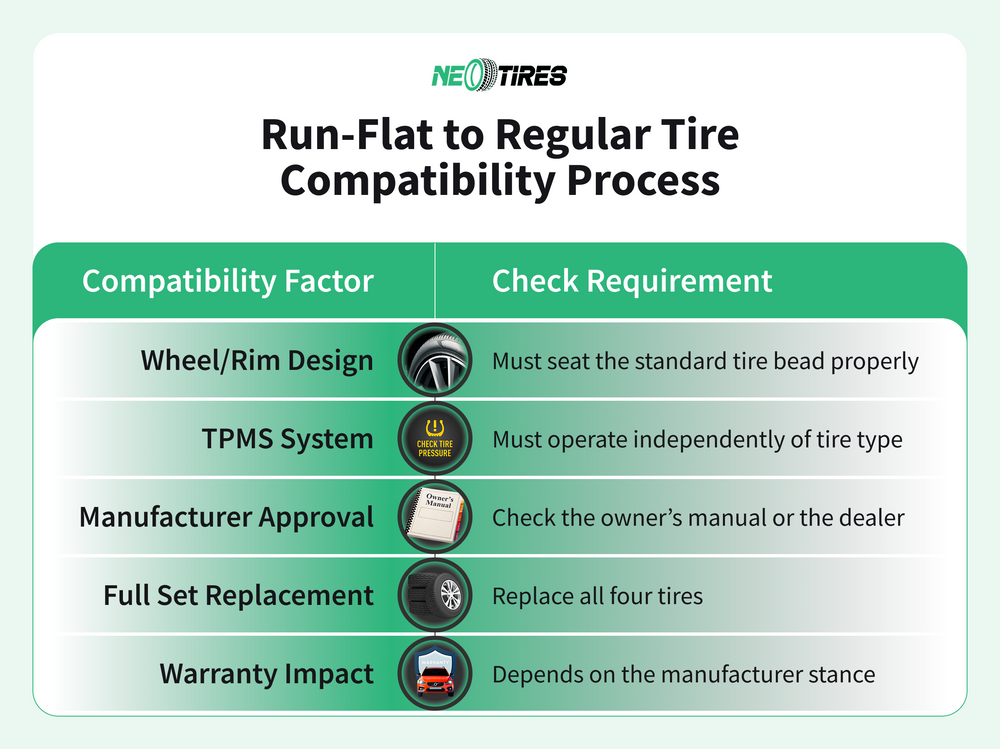
Run-Flat to Normal Tire: Compatibility Table
Compatibility Factor | Check Requirement | Typical Outcome |
Wheel/Rim Design | Must seat the standard tire bead properly | Usually compatible |
TPMS System | Must operate independently of tire type | Compatible with most post-2007 vehicles |
Manufacturer Approval | Check the owner’s manual or the dealer | Varies by brand/model |
Full Set Replacement | Replace all four tires | Mandatory |
Warranty Impact | Depends on the manufacturer stance | Usually unaffected |
 Essential Requirements When Switching from Run-Flats to Regular Tires
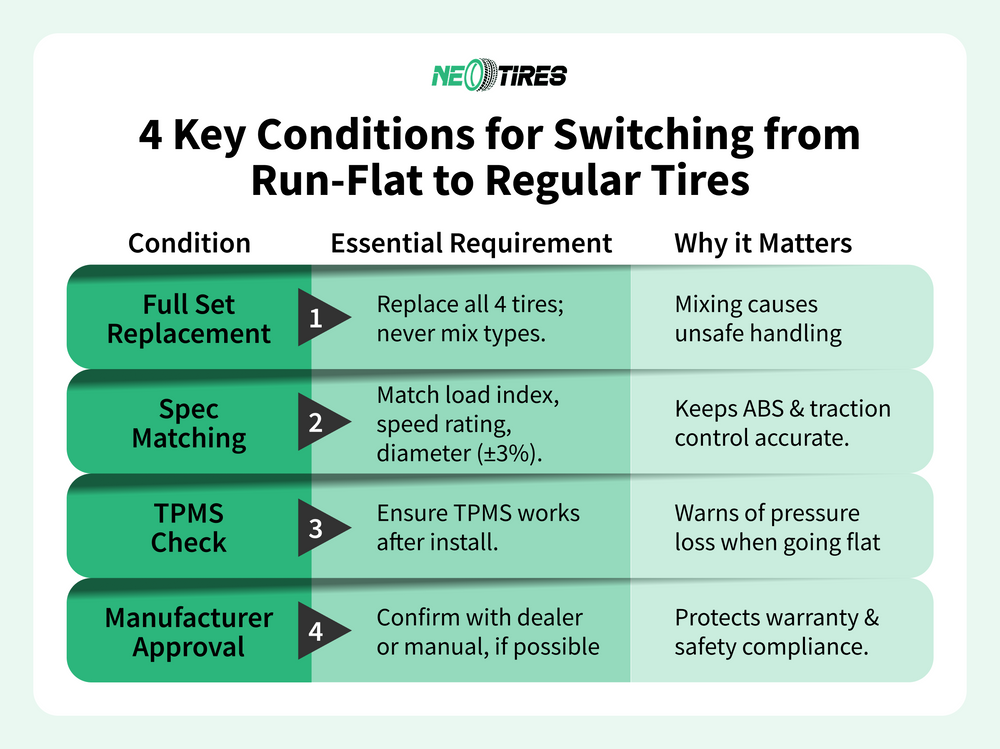
Four key conditions must be met to make the switch from run-flats to normal tires safely:
1. Complete Set Replacement
All four tires must be replaced at the same time. Mixing run-flat and regular tires - even on different axles - causes uneven handling because the sidewall stiffness varies significantly.
Organizations such as USTMA and TyreSafe UK clearly warn against mixing tire construction types.
2. Specification Matching
Replacement tires must meet or exceed your vehicle’s original load index/speed rating, and overall diameter.
A difference greater than ±3% in overall diameter can cause traction control or ABS systems to function incorrectly.
3. TPMS Functionality
Vehicles built after 2007 are required by law (FMVSS 138) to include a Tire Pressure Monitoring System. Make sure your TPMS works correctly with standard tires.
Most direct TPMS setups are unaffected by tire type, though you may still need to perform a system reset after replacing tires. Vehicles with indirect TPMS, such as certain BMW and older Lexus models, may require recalibration to ensure accurate pressure readings.
4. Manufacturer Authorization
Always check your owner’s manual or consult a dealer. Manufacturer policies vary, and approval often depends on your specific make and model.
Safety Checklist: Key Points for Safe Replacement
- ✅ Wheels made for run-flats usually fit regular tires.
- ✅ Match OEM load, speed, and diameter ratings.
- ✅ Replace all four tires together.
- ✅ Never mix tire construction types.
- ✅ Ensure TPMS works correctly.
- ✅ Use a qualified tire shop.
- ✅ Carry a mobility kit or roadside plan.
Major Manufacturer Policies for Switching Tire Types
Manufacturer | Official Position | Key Notes For Changing Run Flats To Normal Tires* |
BMW | No official restriction | Consider a spare tire or repair kit since the car is not equipped to handle a flat |
Mini | No official restriction | If your suspension is tuned for run-flats; expect a change in handling |
Lexus | No official restriction | It's recommended to inform both the dealership and your insurer |
Mercedes-Benz | No official restriction | Ensure the TMPS stays affective with regular tires |
Audi | No official restriction | Replace all four tires |
Porsche | No official restriction | Verify load/speed ratings and ensure proper overall diameter +/-3% |
Key Notes*: The points listed represent general best practices to consider together when switching from run-flat to regular tires. Not every note applies to every brand, but reviewing them all helps ensure a safe and compatible switch.
Run-Flat to Regular Tires: Practical and Performance Differences
While changing run flats to normal tires is generally possible, the ride comfort, cost, mobility, availability, and handling aspects are likely to change, as shown in the table below:
Feature | Run-Flat Tires | Regular Tires |
Ride Comfort | Firm and less forgiving due to reinforced sidewalls | Softer and smoother; better absorption of road bumps |
Cost | Typically higher (around +25-50%) because of specialized construction. | Lower purchase and replacement cost; more budget-friendly overall. |
Puncture Mobility | Can drive up to ~50 miles after a puncture at reduced speed. | No self-supporting capability; requires a spare or repair kit |
Model Availability | More limited selection, especially in non-premium sizes. | A broad range of models, sizes, and performance categories available. |
Handling Feel | Sharper steering response and firmer road feedback. | Slightly softer steering feel; smoother ride, but less precision in aggressive cornering. |
Changing Run-Flats to Normal Tires on BMW Vehicles
Run-flat technology allowed BMW to eliminate the spare tire, reduce weight, and maintain precise handling - explaining why many 2005-2018 models came equipped with them from the factory. Here is what drivers must consider regarding the switch from run flats to normal tires:
BMW’s Official Position (U.S.)
BMW does not publish a model-by-model list that authorizes or prohibits replacing run-flats with conventional tires.
The company generally recommends using BMW-approved tire types for each model. Still, it does not explicitly forbid the use of standard tires when the correct size, load, and speed ratings are maintained.
Owners should confirm suitability with an authorized BMW center using the vehicle’s VIN before making any changes.
Owner and Service Experience (Informational)
While not an official approval, many BMW owners and service centers report successful change from RFTs to standard tires when they follow the proper specifications.
Can You Mix Run-Flat Tires with Regular Tires?
No, you can't. Mixing run-flat and regular tires is unsafe and goes against industry standards. Run-flat tires have much stiffer sidewalls - sometimes nearly twice as rigid - which creates handling imbalances during braking, acceleration, and cornering, if mixed with regular tires.
In practice, mixing the two types, even temporarily, compromises stability and increases stopping distances. Always replace all four tires at once.
The Replacement Process: Step-by-Step
Always have the switch from run-flat to standard tires done at a shop experienced with run-flat-equipped vehicles. The steps usually include:
- Inspecting wheels for prior damage caused by run-flats
- Properly mounting and verifying bead seating
- Balancing and TPMS testing
✅ NeoTires Safety Note: After installation, drive 50-100 miles to allow the tire beads to fully seat and settle. During this period, check for air loss, vibration, or warning lights, as initial tire mounting can sometimes require minor pressure adjustments once the tire fully conforms to the wheel.
Since standard tires don’t offer mobility after a puncture and you’re limited in how far you can drive on a flat tire, make sure to carry a tire repair kit, compact spare, or roadside assistance coverage.
Post-Switch Mobility Options: Protecting Yourself Without Run-Flats
Consider the following options if you prefer to move away from run-flats but still want puncture protection:
Option | How It Works | Pros | Limitations |
Self-sealing tires | Sealant layer inside tire seals punctures up to ¼ of the tread area | Maintains normal ride | Doesn’t seal sidewall damage |
Tire repair kit | Sealant + 12V compressor | Portable, inexpensive | Temporary fix only |
Compact spare tire | Emergency-use spare | Full backup mobility | Requires trunk space |
Key takeaway: Choose an option based on how often and how far you drive from repair facilities.
What Can NeoTires Help You With?
Switching from run-flats to regular tires or finding the right replacement set requires more than just matching numbers on a sidewall. At NeoTires, we help drivers make these decisions confidently.
Our team understands your needs and the practical factors that matter most. We are here to help whether you want to improve ride comfort, lower costs, or find replacements that fit your vehicle's specifications. Our expertise includes:
- Personalized tire recommendations based on your driving habits, climate, and vehicle needs, not just what is available.
- A variety of premium, mid-range, and budget-friendly options are available from leading brands like Toyo, Bridgestone, Continental, Pirelli, and Goodyear. These options include high-performance summer tires as well as all-season and winter tires.
- Run-flat replacements and alternatives for BMW, Mercedes-Benz, MINI, Lexus, and other brands, along with advice on when switching makes sense for your specific model.
- Fast, dependable shipping throughout the United States, so you can have the right tires delivered directly to your installer or doorstep without delay.
Ready to find your perfect tire match? Browse our selection or reach out to our team for personal suggestions based on your vehicle and driving needs. Drive safe and choose your tires wisely!
References
- These references include official safety standards, manufacturer bulletins, and tire industry data used to verify the technical information in this article:
- NHTSA | FMVSS 138 – Tire Pressure Monitoring Systems
- ETRTO | European Tyre and Rim Technical Organisation
- USTMA | Tire Care Safety
- SAE International | Run-flat technology studies
- TyreSafe ORG | What Are Run Flats
- BMW, Lexus, Mini, Mercedes-Benz, Audi | Manufacturer technical bulletins and service documentation (used for reference; not publicly available)
- Bridgestone, Michelin, Continental, Pirelli | Official run-flat tire specifications and product data sheets