


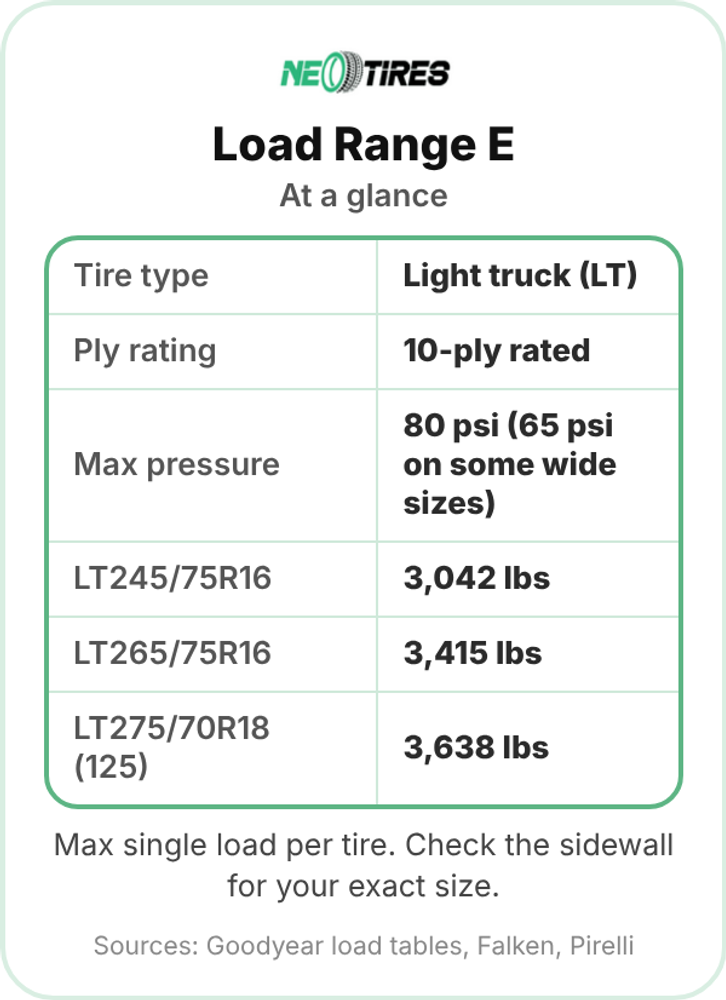
Load Range E tires, also called E-rated tires or tires with an E load rating, are light truck (LT) tires with a 10-ply rating and a maximum inflation pressure of 80 psi (about 550 kPa). How much weight they carry depends on the tire size: in Goodyear's load tables, a Load Range E LT245/75R16 carries up to 3,042 lbs per tire and an LT265/75R16 up to 3,415 lbs, while an LT275/70R18 with load index 125 carries 3,638 lbs. Below you'll find what the E means, the weight capacity and PSI by size, how E compares to C, D, F, and XL tires, and how load range differs from load index.
Load Range E tires are only one part of carrying weight safely; your vehicle still has a rated maximum loaded weight. See our GVWR meaning guide to understand what GVWR includes and where to find it on your truck.
What Is Load Range E on a Tire?
Load Range E is a light truck tire class that sets the tire's maximum load and the inflation pressure it needs to carry it. Light truck tires, including LT-metric and flotation sizes, carry a load range letter such as C, D, or E; the further the letter is in the alphabet, the more load the tire carries at a higher maximum pressure.
- Tire type: LT (light truck) tires, marked "LT" before the size, such as LT275/70R18.
- Ply rating: 10-ply rated.
- Maximum pressure: 80 psi; some wide sizes, such as the LT305/70R16, reach their Load Range E maximum at 65 psi.
- Common use: ¾-ton pickups. Falken's example is a RAM 2500, where a typical size is an LT275/70R18 with load index 125 and Load Range E.
What Are E Rated Tires?
E rated tires are tires with Load Range E. "E rated," "E load rating," and "load range E" all mean the same light truck tire class: 10-ply rated, with a maximum pressure of 80 psi in standard sizes such as the LT245/75R16. The E is the load range letter, not the speed rating, which is a separate letter after the load index.
Is Load Range E 10 Ply?
Yes. Load Range E is the equivalent of a 10-ply rating, as Load Range C is 6-ply rated and Load Range D 8-ply rated. The ply rating is a classification, not a count of layers: a 10-ply rated tire doesn't have 10 plies. It means the tire was built and tested to meet the Load Range E requirements.
Load Range E Weight Capacity and PSI
A Load Range E tire carries between 3,042 and 3,638 lbs per tire in the sizes below, at its maximum pressure. The exact capacity depends on the size, so always check the maximum load and pressure molded on your tire's sidewall.
| Tire Size (Load Range E) | Max Load per Tire (Single) | At |
| LT245/75R16 | 3,042 lbs | 80 psi |
| LT265/70R17 | 3,195 lbs | 80 psi |
| LT265/75R16 | 3,415 lbs | 80 psi |
| LT275/65R18 | 3,415 lbs | 80 psi |
| LT275/70R18 (load index 125) | 3,638 lbs | Load index 125 |
Sources: Goodyear light truck load and inflation tables; LT275/70R18 from Falken (load index 125) and Pirelli's load index chart.
On a dual rear axle, each tire carries less. A Load Range E LT245/75R16 is rated for 2,778 lbs per tire in a dual setup at 80 psi, versus 3,042 lbs as a single.
What PSI Should Load Range E Tires Run?
Run Load Range E tires at the pressure on your vehicle's tire placard, not at the 80 psi maximum on the sidewall. The 80 psi figure is the pressure the tire needs to carry its maximum load. At lower pressure, it carries less: in Goodyear's tables, a Load Range E LT245/75R16 carries 2,623 lbs at 65 psi and 2,205 lbs at 50 psi, the same as a Load Range D or C tire of that size at those pressures. Never inflate below the placard pressure. Learn more in our guide to what tire PSI your tires should be.
Do All Load Range E Tires Max Out at 80 PSI?
No. Maximum pressure isn't always the same for a given load range, as Bridgestone notes. In Goodyear's load tables, the LT305/70R16 reaches its Load Range E maximum load at 65 psi, while Load Range F in that size reaches its maximum at 80 psi. Check the "max load" and "max press" markings on the sidewall of your exact size.
Load Range E vs D vs C Tires
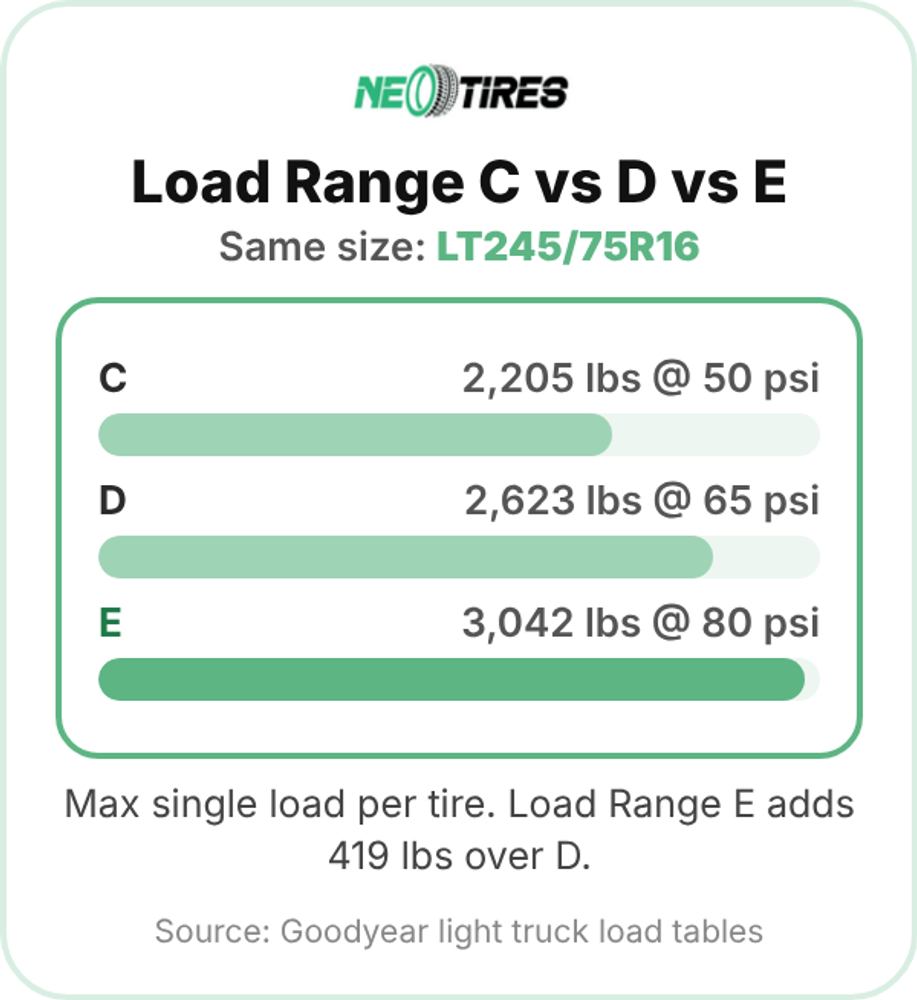
A Load Range E tire carries more weight than a Load Range D or C tire of the same size because it's built for a higher maximum pressure. In the same LT245/75R16 size:
- Load Range C (6-ply rated): 2,205 lbs at 50 psi.
- Load Range D (8-ply rated): 2,623 lbs at 65 psi.
- Load Range E (10-ply rated): 3,042 lbs at 80 psi.
That's 419 lbs more per tire than Load Range D and 837 lbs more than Load Range C, or 1,676 lbs and 3,348 lbs more across four tires.
Load Range E vs F Tires
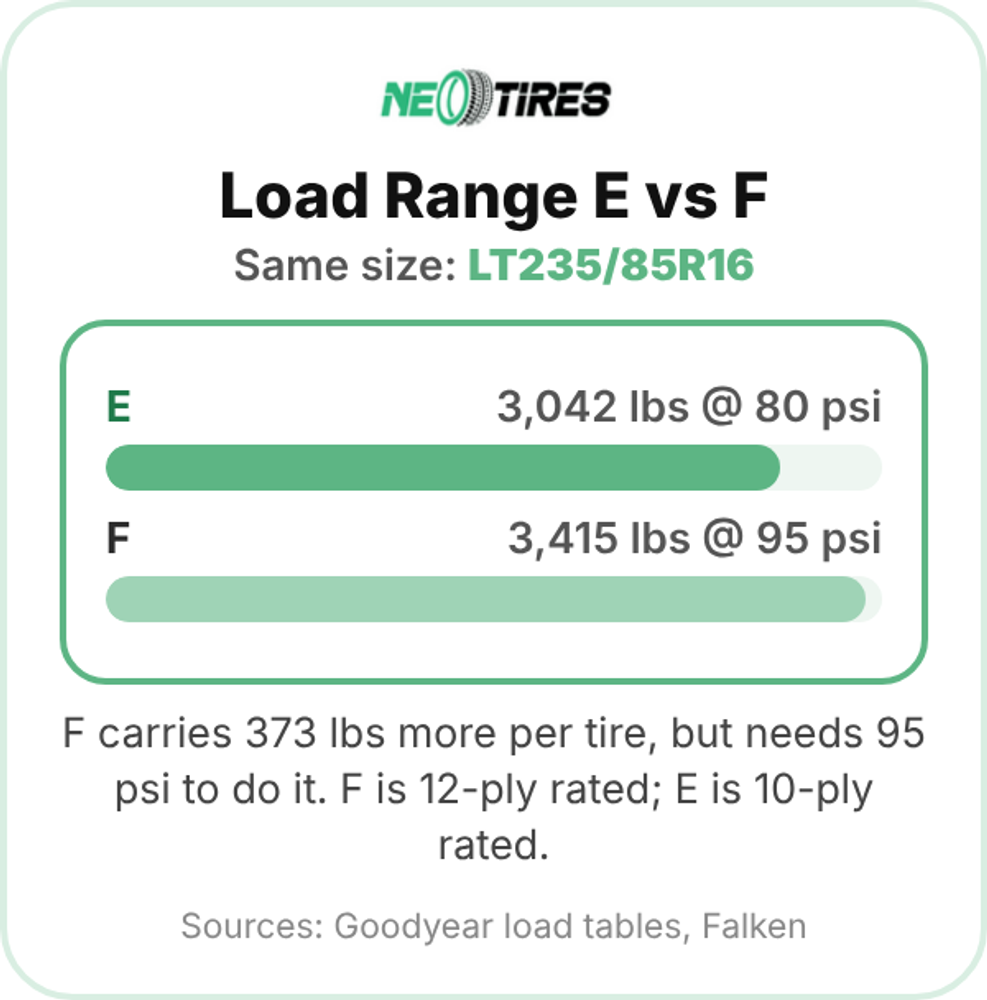
Load Range F tires carry more weight than Load Range E but need a higher maximum pressure to do it. In Goodyear's tables for the LT235/85R16, Load Range E carries 3,042 lbs at 80 psi and Load Range F carries 3,415 lbs at 95 psi: 373 lbs more per tire.
- Ply rating: Load Range F is 12-ply rated; Load Range E is 10-ply rated.
- Testing: higher load ranges must pass more demanding endurance and high-speed tests, according to Falken.
- Who uses F: Falken links Load Range F to the growing weight of ¾-ton and 1-ton pickups and to larger aftermarket tire sizes, which need a load index that meets or exceeds the original tire's.
Load Range vs Load Index: What's the Difference?
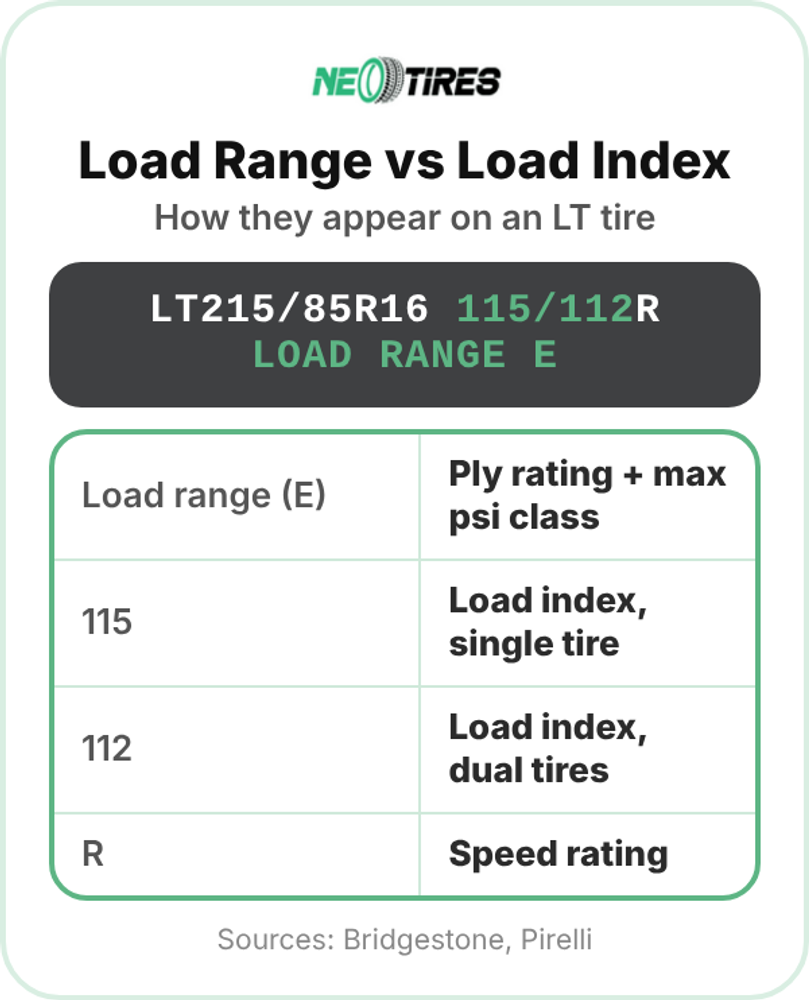
The load range letter tells you the tire's ply rating and maximum pressure class; the load index number tells you how much weight it carries. On LT tires, the load index usually has two numbers separated by a slash: the first is the load per tire as a single, the second as a dual. Bridgestone's example is an LT215/85R16 Load Range E with the service description 115/112R:
- 115: load index as a single tire.
- 112: load index as a dual tire.
- R: speed rating.
See how to read the tire load index and speed rating in our full guide.
Load Range E vs XL and SL Tires
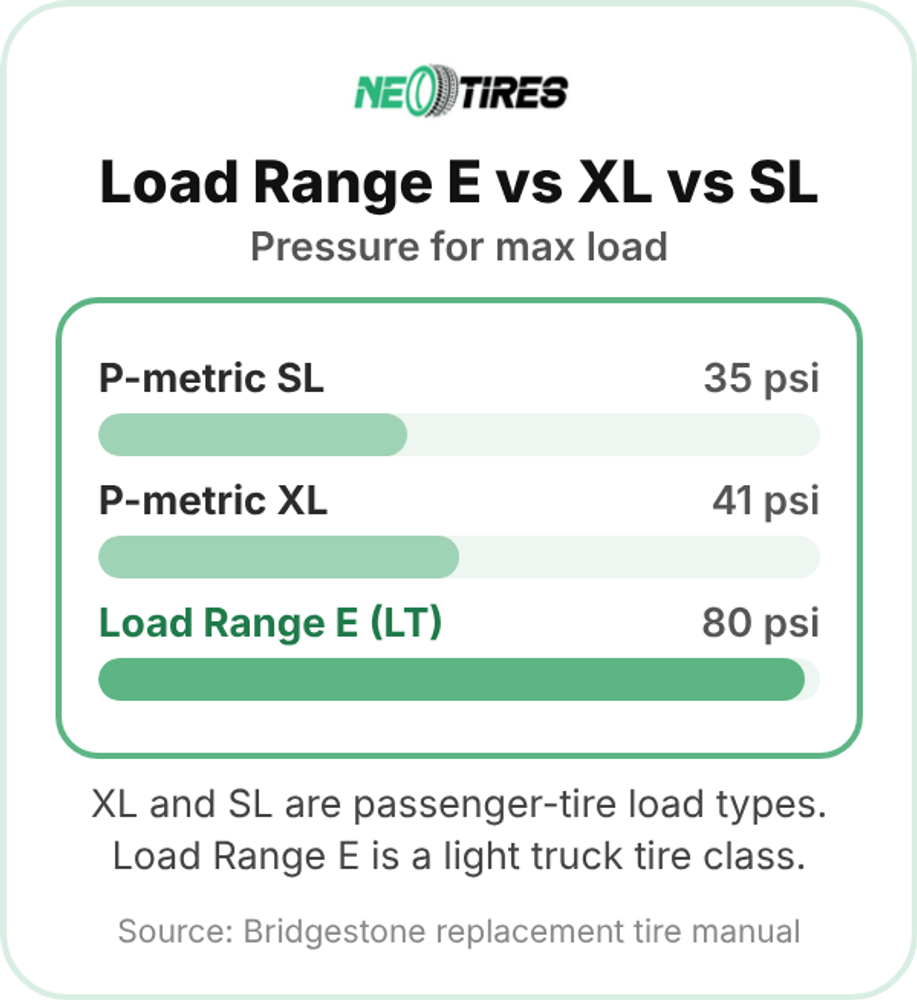
Load Range E is a light truck tire class; XL (Extra Load) and SL (Standard Load) are load types for passenger tires. They differ in the pressure needed for maximum load: P-metric SL tires reach their maximum load at 35 psi and P-metric XL tires at 41 psi, according to Bridgestone, while Load Range E LT tires go up to 80 psi.
- Don't swap LT for passenger tires: Bridgestone does not recommend replacing original LT tires with P-metric or Euro-metric passenger tires unless the vehicle manufacturer specifies it.
- Passenger tires lose capacity on a truck: a P-metric tire used on a light truck has its load capacity divided by 1.1.
- XL doesn't equal E: an XL tire is a stronger passenger tire, not a light truck tire.
Do You Need Load Range E Tires?
You need Load Range E tires if your vehicle came with them or if your load and towing needs exceed what your current tires carry. Never pick a replacement tire with less load capacity than the tire on your vehicle's placard, and if you upsize, choose a load index that meets or exceeds the original tire's. Check your truck's GVWR and towing ratings too, since the tires can't raise those limits.
How Fast Can You Drive on Load Range E Tires?
Load range doesn't set a tire's speed limit; the speed rating does. It's the letter after the load index, such as the "R" in 115/112R. Keep the tires inflated to the placard pressure and within their load rating, because underinflation and overloading build up heat in the tire.
Ready to upgrade to Load Range E? Get $20 off a set of 4 tires or $15 off 2 tires on your first order, and free shipping on tires labeled Free Shipping:
- Continental TerrainContact H/T, rated 4.9 stars
- Toyo Open Country A/T III, rated 4.9 stars
Or browse all light truck tires.
Choose Tires With the Right E Load Rating with NeoTires
The right load range matches your vehicle's placard and the weight you carry or tow. NeoTires dispatches orders the same day and delivers in 2–3 business days across the U.S., and tires labeled Free Shipping ship free. Explore our catalog of tires by size or vehicle, or call us at +1 302 276 8361 to confirm the right load range before you order. Drive safe and choose your tires wisely!
Why Trust Us?
For several years now, NeoTires has been specializing in professional customer service in all tire-related matters. From offering market-approved products to in-depth guidance in the buying process, NeoTires offers qualified assistance to satisfy drivers with services and products. Our philosophy is based on several pillars, among which are:
Unbiased Information: Our reviews and recommendations are independent, with no influence from manufacturers or other sellers.
No Paid Promotions: We don't display third-party ads or accept payments for product promotion. Our reviews and recommendations are strictly derived from our own tests and market studies.
Expert Research: We rely exclusively on trusted sources like NHTSA, Tire and Rubber Association, Consumer Reports, or SAE reports for our comprehensive tire assessments.
Professional Experience: Our team of industry veterans takes their jobs seriously to solve all customer needs and provide efficient solutions;
User-Friendly Tools: We ensure that consumers have all the necessary tools for a smooth online buying process. These include, but are not limited to, securing online payments, tracking, and fast delivery service.
Customer-Centric Approach: Your satisfaction and driving safety are our top priorities. Learn more about our philosophy and what our customers say about us on Trustpilot.
Sources